Often times we try to improve processes by moving quickly to solutions. We add a form, automate a step, change a handover, or train people to work faster. Sometimes this helps, but often the same delays, rework, unclear ownership, and recurring issues return. One reason is simple: we have not asked enough good questions before changing the process.
In business process optimisation, asking “why?” helps managers, process owners, and analysts understand what is really happening inside the process. It helps separate value-add work from non-value-add activity, and it helps teams avoid fixing symptoms while the real problem remains untouched.
In this article
• Why asking “why?” matters in process optimisation
• Process problems hide inside routine work
• Non-value-add activity is not always obvious
• Good questions come from knowledge and observation
• Better process owners make questioning part of the system
• Better questions lead to better execution
Process problems are often hidden inside routine work
Most process problems do not appear as one large failure. They show up as small daily frustrations.
A customer waits longer than expected. A team member asks the same clarification again. A manager chases an update. A report is corrected three times. A request moves between departments because nobody is sure who owns the next step.
Over time, people accept these issues as normal. They build workarounds. They add extra checks. They create side spreadsheets. They rely on experienced people to remember what the process itself does not make clear.
This is where asking “why?” becomes powerful.
Why does this request need to be checked again?
Why does this approval take three days?
Why does the same information need to be entered twice?
Why does the customer contact support after this step?
Why does the team wait before moving the work forward?
These questions are simple, but they are not basic. When asked carefully, they reveal the difference between work that creates value and work that exists only because the process is unclear, disconnected, or poorly controlled.
A process cannot be optimised properly until people understand why the current work exists.
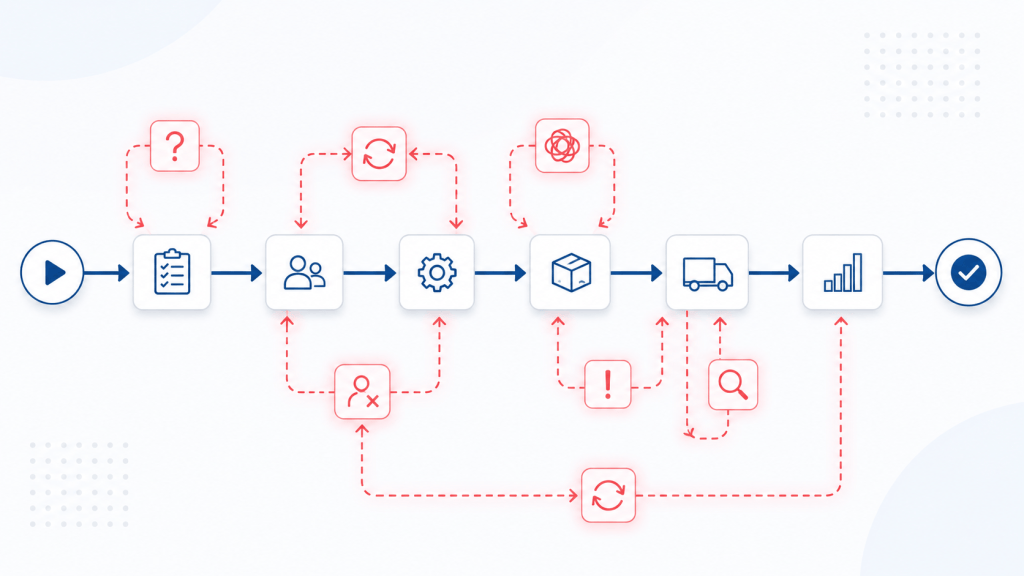
Non-value-add activity is not always obvious
Many non-value-add activities look useful because they have been part of the process for a long time.
A duplicate approval may look like control. A manual tracker may look like visibility. A recurring meeting may look like alignment. A rework step may look like quality management. In reality, these activities may exist because the process has gaps in ownership, unclear decision rules, poor data quality, or weak handovers.
For example, a team may spend time checking every customer request manually. At first, this appears careful and responsible. But asking “why?” may show that the check exists because the intake form is unclear, mandatory information is missing, or previous teams do not trust the data they receive.
In this case, the better solution is not to ask people to check faster. The better solution is to improve the source of the information, clarify the process rules, and reduce the need for repeated checking.
This is where many improvement efforts fail. Teams jump to solutions that make the visible activity more efficient, instead of questioning whether the activity should exist at all.
A process analyst or process owner adds real value by slowing down enough to understand the work. They observe how people actually complete tasks, where they pause, what they chase, what they correct, and what they do outside the official process.
Strong questioning does not mean blaming people. It means respecting the reality of their work and using that reality to improve the system around them.
The best process improvements often come from removing unnecessary work, not from making unnecessary work faster.

Good questions come from knowledge and observation
The ability to ask great process questions usually comes from two sources: knowledge of the process and keen observation.
Knowledge helps people understand what should happen. Observation helps them see what actually happens.
A process owner who understands the full flow can ask better questions about ownership, timing, inputs, outputs, and decision points. A process analyst who observes carefully can notice delays, handover issues, repeated clarifications, and informal workarounds that may not appear in the documented process.
For example, a documented process may say that Sales sends complete information to Operations. But observation may show that Operations regularly asks Sales for missing details. The question is not only, “Why did Sales forget?” A stronger question is, “Why does the process allow incomplete information to move forward?”
That question changes the conversation. It moves the focus from individual behaviour to process design.
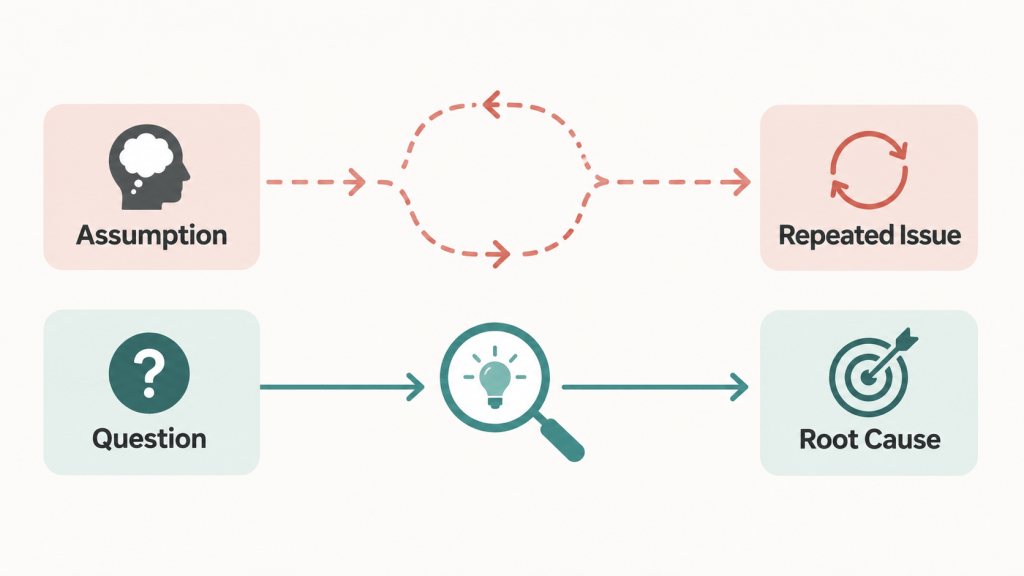
Good questioning also helps managers avoid over-reliance on assumptions. A manager may assume a delay is caused by workload, but the real cause may be unclear prioritisation. A team may assume rework is caused by carelessness, but the real cause may be inconsistent instructions. A leader may assume a process needs automation, but the real issue may be ownership.
The quality of the question determines the quality of the improvement.
Better questions include:
• What decision is this step supporting?
• What happens if this step is removed?
• Who uses the output of this activity?
• Where does rework most often enter the process?
• What information is missing at the point of handover?
• Which issues keep coming back even after corrective action?
These questions help teams move beyond surface-level fixes. They create a clearer view of where the process is weak and where improvement should be focused.
Good process questions turn assumptions into evidence.
Excellent organisations manage questioning as part of the system
In many organisations, process improvement depends on individual effort. One manager asks good questions. One analyst investigates deeply. One team improves its own workflow. These efforts may create local benefits, but they often remain scattered.
The stronger approach is to make questioning part of how the organisation manages improvement.
This means recurring issues are not only closed quickly. They are reviewed to understand why they happened. Delays are not only escalated. They are studied to identify process gaps. Rework is not only corrected. It is analysed to find where the process failed to produce the right output the first time.
Excellent organisations create routines where teams ask the right questions consistently. They define process ownership. They clarify accountability. They connect improvement activity to business priorities. They use evidence from daily work to improve the system, not just to solve one incident.
This is especially important as organisations grow. Informal knowledge may work when teams are small, but it becomes risky when work volumes increase, teams change, or processes cross multiple departments. Without a managed system, the same problems return in different forms.
Asking “why?” should not be treated as a one-time workshop technique. It should be part of how managers, professionals, consultants, and process owners review performance, investigate issues, and improve execution.
Operational Excellence supports this shift. It helps organisations move from scattered improvement activity to a structured management system where process problems are identified, questioned, prioritised, and improved in a disciplined way.
The real power of “why?” is better execution
The purpose of asking “why?” is not to make processes look perfect on paper. The purpose is to make work easier to execute, easier to manage, and easier to improve.
When organisations ask better questions, they find the causes behind delays, rework, unclear ownership, process gaps, support contacts, and inconsistent execution. They also reduce the risk of investing time and money in solutions that do not address the real problem.
This is why asking “why?” is one of the strongest capabilities a process analyst, process owner, or improvement leader can develop. It helps people see what others miss. It helps teams challenge inherited ways of working. It helps organisations remove work that does not create value.
At Operational Excellence Simplified, this point of view is central to PATH OEMS™. Sustainable improvement does not come from isolated fixes. It comes from managing improvement as a system, with the right questions, ownership, routines, and follow-through.
If your organisation is dealing with recurring issues, process gaps, unclear ownership, or improvement activity that does not seem to stick, it may be time to look beyond the symptoms and ask better questions about the system behind the work.
Leave a Reply