AI is creating real opportunities in process improvement, but it can also create a familiar problem. A manager, process owner, or business leader may become excited about the technology before they fully understand the process. When that happens, AI can be added to unclear workflows, weak handovers, poor data, and inconsistent execution. The result is not always better performance. Sometimes it is simply a faster version of the same problem.
AI in process improvement should not start with the question, “Where can we use AI?” It should start with a more practical question: “Which process problem are we trying to solve, and is the process strong enough to scale?”
In this article
• Why AI excitement can distract from process fundamentals
• How technology can scale the wrong process
• Why old-school process improvement principles still matter
• How a process owner can decide where AI genuinely helps
• Why AI should scale success, not confusion
• How Operational Excellence supports technology-led improvement
AI is powerful, but it is not a process strategy
There is nothing wrong with being excited about AI. It can support faster analysis, improve visibility, reduce manual effort, summarise information, identify patterns, and help people work more efficiently. For a process owner, these are valuable possibilities.
The risk begins when AI becomes the starting point instead of the supporting tool.
This is not new. The same pattern has happened with many technologies. A new system appears. A new platform becomes popular. A new automation tool promises speed, control, or efficiency. The person leading the work then tries to fit the technology into the strategy, rather than using the strategy to decide where technology belongs.
That is when process improvement becomes tool-led instead of problem-led.
A process owner may say, “We need AI in this workflow,” before asking whether the workflow is clear, stable, owned, measured, and understood. A manager may automate a task before questioning why the task exists. A consultant may recommend a digital solution before confirming whether the current process design makes sense.
AI can help, but it cannot replace basic process thinking. If the process has unclear ownership, AI will not automatically create accountability. If the process has poor inputs, AI will not magically create reliable outputs. If the process has too many exceptions, AI may simply process those exceptions faster.
AI should support process strategy. It should not become the process strategy.
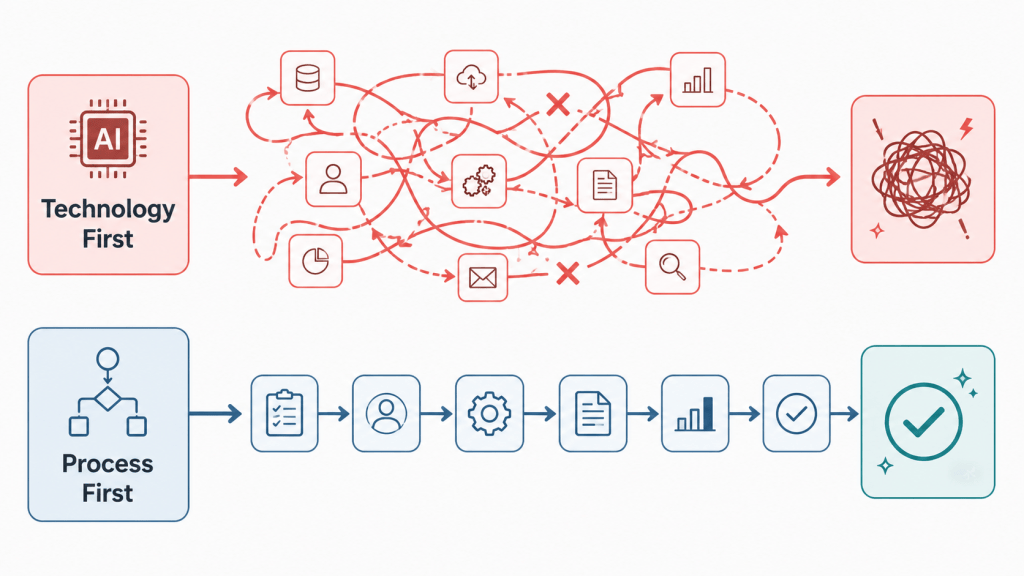
Technology can scale the wrong process
One of the biggest risks with AI and automation is that they can make a bad process move faster.
If a process creates rework manually, technology may create rework at scale. If a process sends incomplete information from one team to another, automation may move incomplete information faster. If a process has unclear decision rules, AI may help produce faster outputs, but those outputs may still need review, correction, or escalation.
This is why a process owner should be careful before introducing technology into a weak process.
For example, a customer support team may receive repeated contacts because customers do not understand the next step in a service journey. AI could be used to respond faster to those contacts. That may reduce response time, but it does not solve the process problem. The better question is: why are customers contacting support in the first place?
If the real issue is unclear communication, missing updates, confusing instructions, or weak handover between teams, then AI support responses are only treating the symptom. The process owner may need to improve the customer journey, clarify ownership, simplify communication, and remove the cause of the support contact.
The same applies to internal processes. If a team uses three spreadsheets because the official system does not provide the right visibility, AI may help summarise the spreadsheets. But the deeper question remains: why do three spreadsheets exist?
Technology should not be used to protect unnecessary work. It should help remove, reduce, or scale the right work.
When technology is added to the wrong process, it can scale waste instead of value.

Old-school process improvement principles still matter
The rise of AI does not make process fundamentals less important. It makes them more important.
Before using AI in process improvement, a process owner still needs to understand the purpose of the process, the customer or user need, the inputs, the outputs, the handovers, the decision points, the controls, and the pain points. They still need to ask where delays happen, where rework enters, where ownership is unclear, and where the process depends too heavily on individual memory.
These are old-school process improvement principles, but they remain highly relevant.
A process map still helps people see the real flow of work. A root cause discussion still helps separate symptoms from causes. A review of value-add and non-value-add activity still helps identify waste. Clear ownership still matters. Standard work still matters. Measurement still matters. Follow-through still matters.
AI does not remove the need for these basics. In many cases, AI depends on them.
If the process is not clearly defined, AI has no stable foundation to support. If the data is unreliable, AI may produce outputs that look confident but still require correction. If the process owner has not defined success, it becomes difficult to know whether AI has improved the process or simply changed the way work is done.
This does not mean a process must be perfect before technology is introduced. That would be unrealistic. It means the person leading the improvement should know what problem they are solving and what good performance should look like.
AI works best when it is applied to a process that has been understood, simplified, and stabilised enough to benefit from scale.
Strong process fundamentals make AI more useful, not less necessary.
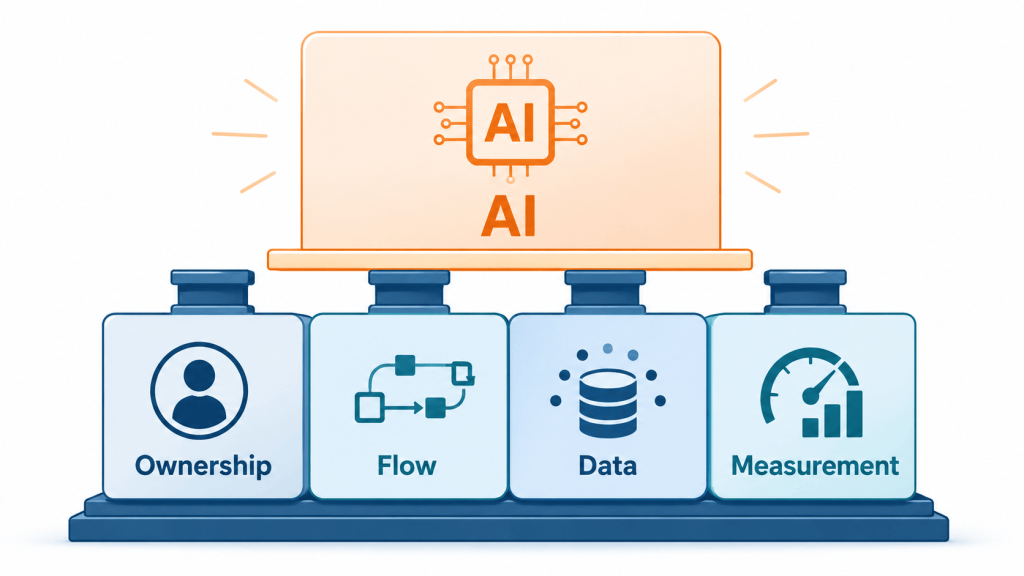
A process owner should use AI to scale what already works
A practical process owner does not reject AI. They also do not add it everywhere.
They look for places where AI can scale success, reduce friction, improve visibility, or support better decisions without hiding process problems. They ask whether the task is repetitive, whether the input is reliable, whether the decision rules are clear, whether the risk is manageable, and whether the output will be used in a controlled way.
AI may be useful when a process owner wants to analyse large volumes of feedback, summarise recurring issues, route information, detect patterns, generate draft responses, support documentation, or help teams find information faster.
But the process owner should still ask disciplined questions before moving forward.
What problem is AI solving?
Is the current process understood?
Is the activity value-add or non-value-add?
Should this step be improved, removed, or automated?
What could go wrong if the output is incorrect?
Who owns the process after AI is introduced?
How will performance be measured?
These questions keep the improvement grounded. They help the manager avoid using AI as a shortcut around process thinking.
The goal is not to make the process look modern. The goal is to make the process work better.
The better question is not “Where can we use AI?”
The better question is, “Where can AI help us improve a process that is already aligned with our business priorities?”
That shift matters.
It moves the conversation from technology excitement to process discipline. It helps the person leading the improvement focus on value, ownership, execution, and measurable outcomes. It also reduces the risk of adding tools that increase complexity rather than reduce it.
AI should help scale the right process. It should not be used to compensate for unclear ownership, weak design, poor data, or inconsistent execution. If a process is broken, the first responsibility is to understand it and improve it. Once that foundation is in place, AI may become a strong enabler.
At Operational Excellence Simplified, this is central to how we think about improvement. PATH OEMS™ is built around the idea that improvement should be managed as a system, not as scattered activities or tool-led initiatives. Technology can be valuable, but it should sit within a clear Operational Excellence approach that connects process ownership, business priorities, improvement routines, and follow-through.
If you are considering AI in process improvement, start with the process. Understand the problem. Clarify ownership. Remove unnecessary work. Stabilise what matters. Then use technology to scale what is working, not to accelerate what is broken.
Leave a Reply