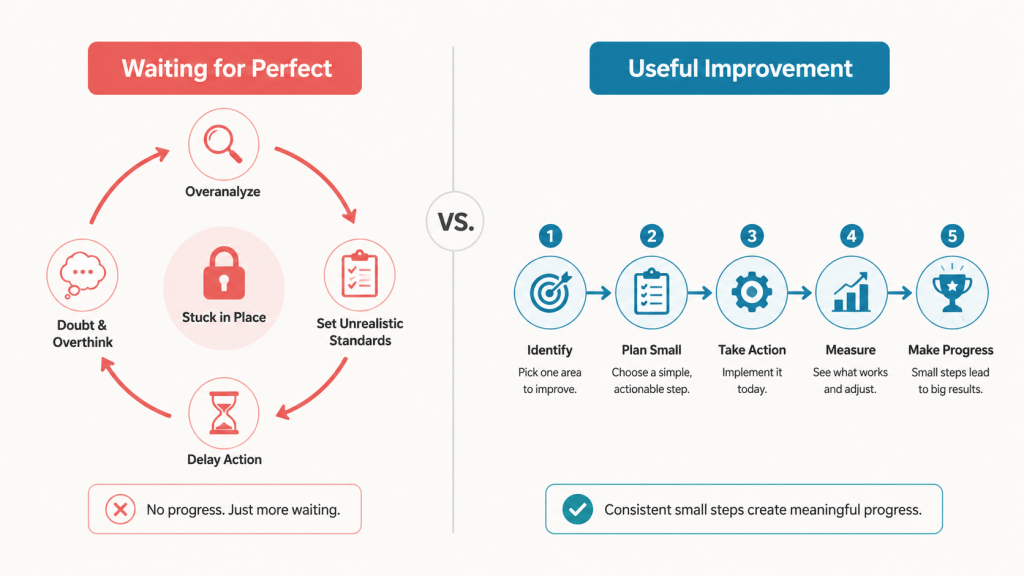
Many process improvements are delayed because the person leading the work wants the solution to be perfect before anything changes. They want every exception mapped, every stakeholder aligned, every document finalised, and every future scenario predicted. The intention is usually good. They want to avoid mistakes. But in process improvement, waiting too long can become more expensive than starting with an imperfect but useful improvement.
Progress over perfection does not mean accepting poor work. It means improving the process early enough to reduce delays, rework, confusion, support contacts, and inconsistent execution before those problems become normal.
In this article
• Why perfection slows process improvement
• How delay creates hidden business cost
• Why imperfect improvement can still reduce waste
• How a process owner can manage risk without waiting too long
• Why progress needs structure, not guesswork
• How Operational Excellence supports practical improvement
Perfection can become a reason to delay improvement
A process owner, manager, analyst, or consultant may delay an improvement because they want more certainty. They may keep refining the process map, rewriting the procedure, asking for more feedback, or waiting for a future system change.
Some of this is useful. A rushed change can create confusion. A poorly understood process can lead to weak decisions. But there is a point where preparation stops supporting improvement and starts blocking it.
The problem is that the current process continues to operate while the improvement waits.
The same delays continue. The same handover issues remain. The same customer questions reach the support team. The same reports need correction. The same team members chase updates, clarify ownership, and work around process gaps.
In many cases, the process does not need a perfect future-state design before the first improvement can be made. It may need one clear decision rule, one better handover, one removed duplicate check, one clearer owner, or one improved communication point.
A process owner should ask: what can be improved safely now, even if the full process is not perfect yet?
That question helps the person leading the improvement avoid turning perfection into delay.
A process does not need to be perfect before it can be better.
The cost of delay is often hidden
The cost of imperfection is usually visible. A process owner can see that a draft procedure has gaps. A manager can see that the new handover is not ideal. A consultant can see that a process map still has unanswered questions.
The cost of delay is often less visible.
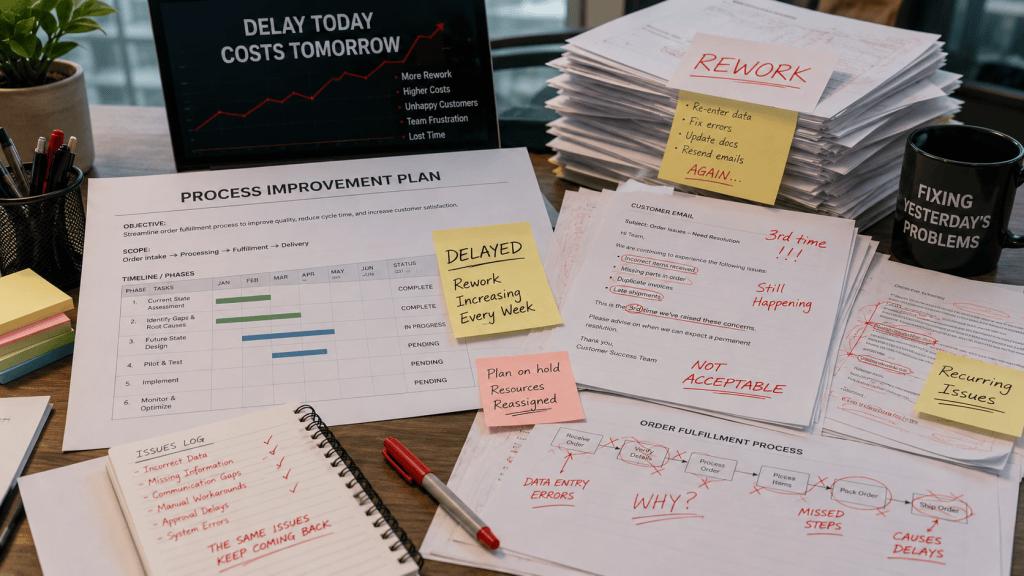
Delay appears as time lost across many small moments. A team member spends ten minutes clarifying the same issue again. A customer sends another email because the next step was unclear. A supervisor checks work manually because the process does not create enough confidence. A report is corrected for the third time. A task waits because no one is sure who should act next.
Individually, these issues may look small. Together, they become expensive.
The process owner may believe they are avoiding risk by waiting. In reality, they may be allowing daily waste to continue. The imperfect improvement they are delaying may not solve everything, but it may reduce enough friction to create value now.
For example, a customer onboarding process may have several weaknesses. The full redesign may take weeks. But if the biggest issue is that customers do not know what documents to prepare, a simple preparation checklist could reduce support contacts immediately. The checklist may not be perfect. It may need revision after feedback. But it can still reduce confusion faster than waiting for a complete redesign.
This is the practical meaning of progress over perfection.
The goal is not to launch unfinished work carelessly. The goal is to understand where delay is costing the business more than a controlled, imperfect improvement would.
The cost of delay is often spread across repeated small problems, which makes it easy to underestimate.
Imperfect improvement can still reduce waste
A useful process improvement does not have to solve every problem at once.
A process owner may start by improving the part of the process that creates the most delay, rework, or confusion. They may clarify one ownership point, simplify one approval, improve one intake form, or remove one duplicated task. These changes may be small, but they can reduce non-value-add work quickly.
This approach works because many process problems are not caused by one large failure. They are caused by repeated friction in daily execution.
If a team regularly receives incomplete information, a better intake checklist can help. If decisions wait because authority is unclear, a simple decision rule can help. If customers contact support because they do not know the next step, a clearer update message can help. If managers chase status updates, a visible tracker with agreed ownership can help.
None of these improvements need to be perfect to be useful.
The important question is whether the change reduces a real process problem without creating unacceptable risk.
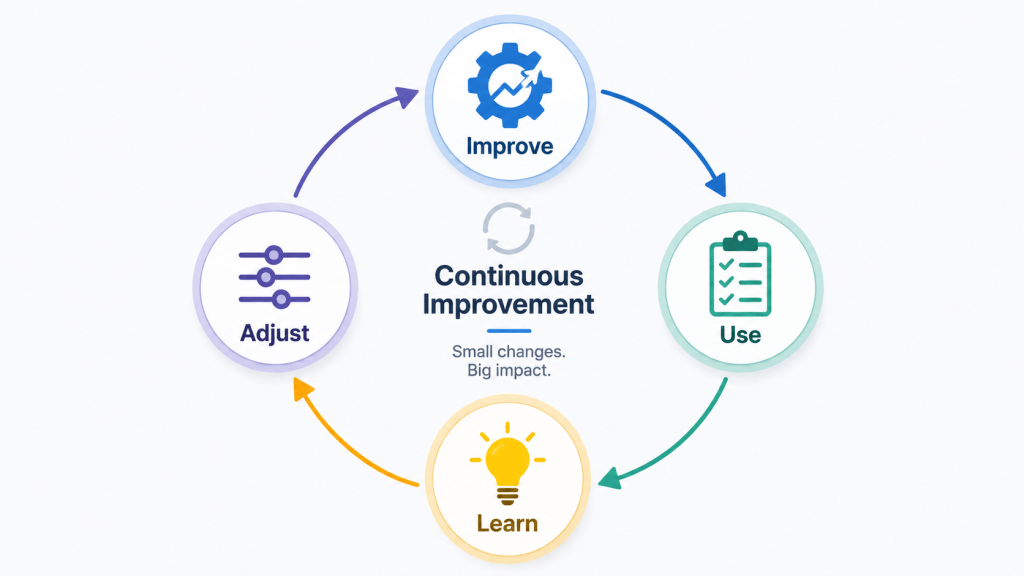
A process owner should treat improvement as a controlled learning cycle. They make a practical change, observe how it works, collect feedback, and adjust. This is often better than trying to design the final answer without testing it in real work.
Perfection usually assumes the person can predict everything in advance. Process improvement works better when the person learns from execution.
A small improvement tested in real work often teaches more than a perfect plan that has not been used.
Progress still needs structure and discipline
Progress over perfection should not become an excuse for careless change.
A process owner still needs to understand the problem, define the intended outcome, consider risk, communicate the change, and review whether the improvement worked. Moving faster does not mean ignoring control. It means applying enough control to improve safely without unnecessary delay.
Before making a change, the person leading the improvement can ask a few practical questions.
What problem are we trying to reduce?
Which part of the process is causing the most friction?
What is the smallest useful improvement we can make?
What risk could this change create?
Who needs to know about the change?
How will we know whether it helped?
When will we review and adjust it?
These questions keep the improvement grounded. They help the process owner avoid both extremes: waiting too long for perfection or making random changes without discipline.
The better approach is controlled progress.
A process owner can make an improvement visible, define who owns it, communicate what has changed, and review its effect after a reasonable period. If it works, they can standardise it. If it partly works, they can refine it. If it creates a new issue, they can adjust it.
This is how process improvement becomes practical rather than theoretical.
Better execution comes from improving sooner and learning faster
The real value of progress over perfection is better execution.
When a process owner improves sooner, they reduce the time the business spends living with avoidable problems. They also learn from real use instead of relying only on assumptions. This helps them build a stronger process step by step.
The cost of imperfection should not be ignored. A poor process change can create confusion, rework, or risk. But the cost of delay should not be ignored either. Waiting too long can allow known issues to continue, frustrate teams, affect customers, and weaken confidence in improvement work.
A practical process owner balances both.
They do not wait for a perfect solution when a safe and useful improvement is available. They also do not make uncontrolled changes just to appear busy. They improve deliberately, review honestly, and adjust based on evidence.
At Operational Excellence Simplified, this is central to the way we think about improvement. PATH OEMS™ supports the idea that improvement should be managed as a system, not as scattered activity or endless planning. A strong Operational Excellence approach helps the person leading improvement identify priorities, clarify ownership, act with discipline, and keep improving through structured follow-through.
If your process has known delays, rework, unclear ownership, recurring issues, or avoidable support contacts, waiting for the perfect solution may not be the best option. The better question may be: what useful improvement can be made now, safely, and reviewed properly?
Progress does not mean lowering standards. It means reducing the cost of delay while building a stronger process over time.
Leave a Reply