Process ownership is often treated as a technical responsibility. The process owner is expected to understand the workflow, maintain documentation, monitor KPIs, manage issues, and support improvement activity. These responsibilities are necessary, but they are not sufficient.
A process map can show how work should move. A procedure can define what people should do. A KPI can show whether performance is improving or declining. None of these tools can create trust, accountability, honest communication, or sustained behavioural change by themselves.
That is why emotional intelligence matters in process ownership.
Process ownership is a leadership responsibility. It requires the process owner to influence people who operate, support, improve, and depend on the process. Many processes cross departments, systems, roles, and priorities. The process owner often needs cooperation from people outside their direct reporting line.
The strength of process ownership therefore, depends on two things: the quality of the process system and the quality of the human behaviours around that system.

Why process ownership is more than process documentation
A documented process is not the same as an owned process.
A process may have an approved workflow, a named owner, a current SOP, and a review meeting. Yet the real work may still depend on informal workarounds, side spreadsheets, personal memory, repeated clarifications, and escalations. In that situation, the organisation has documentation, but not effective ownership.
A process owner is responsible for the health and performance of the process over time. That includes how the process is defined, executed, reviewed, improved, and sustained.
| Process ownership area | Technical requirement | Behavioural requirement |
| Process definition | Clear steps, inputs, outputs, roles, controls | Shared understanding and acceptance |
| Performance management | KPIs, targets, review cadence | Honest reporting and accountability |
| Improvement | Root cause analysis, prioritisation, action tracking | Openness, collaboration, and follow-through |
| Compliance | SOPs, training, audits, controls | Daily commitment to agreed standards |
| Sustenance | Governance routines and ownership reviews | Consistent behaviours over time |
The technical side creates structure. The behavioural side determines whether the structure is used.
If the process owner only manages documentation, process ownership becomes administrative. If the process owner leads behaviour, process ownership becomes operational leadership.
How emotional intelligence improves process performance
Emotional intelligence is the ability to understand and manage one’s own behaviour while understanding and influencing the behaviour of others. In process ownership, this does not mean avoiding difficult conversations or accepting poor performance. It means leading process performance in a way that increases transparency, cooperation, and disciplined improvement.
An emotionally intelligent process owner can:
Notice when people are reluctant to speak openly.
Separate process failure from personal blame.
Understand resistance before dismissing it.
Communicate expectations without creating unnecessary defensiveness.
Build cooperation across departments.
Keep improvement discussions focused on facts, causes, and outcomes.
Reinforce standards after implementation.
These behaviours matter because process problems are often hidden inside daily work. People may know that a handover is weak, a form is unclear, a KPI is manually adjusted, or a workaround has become normal. They may not raise it if they expect criticism, inaction, or blame.
The process owner cannot improve what the organisation is unwilling to reveal.
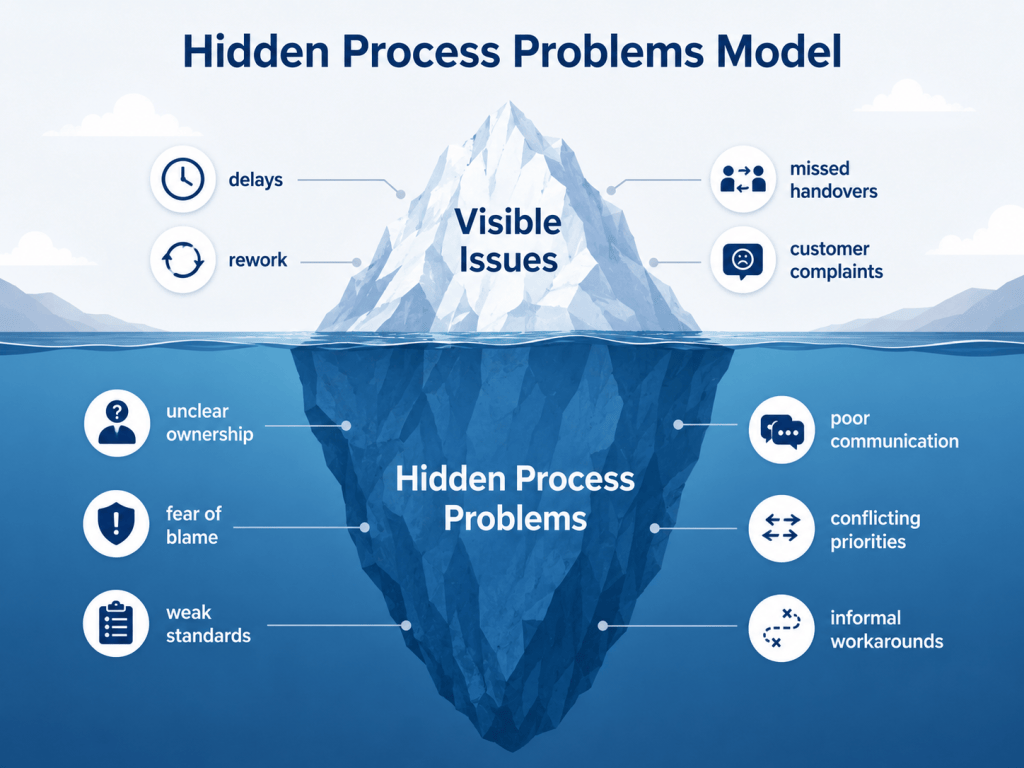
Trust increases issue visibility
Trust is one of the most important operating conditions for effective process ownership.
When teams trust the process owner, they are more likely to raise issues early, explain what is really happening, and admit where the documented process does not match daily execution. When trust is low, people may share only the acceptable version of the problem.
This creates a serious operational risk. Leaders may make process decisions based on incomplete information.
For example, a department may repeatedly send incomplete information to another team. A low-trust review may focus on who failed to complete the form. A stronger process ownership review asks:
Was the required information clearly defined?
Did the sending team understand how the receiving team uses it?
Are mandatory fields built into the system?
Is there a quality check before handover?
Is poor input quality measured?
Has this issue repeated across customers, products, or teams?
These questions move the discussion from personal criticism to process diagnosis. The goal is not to protect people from accountability. The goal is to direct accountability toward the cause.
Trust improves process ownership because it improves the quality of operational information.
Psychological safety supports early problem detection
Process owners need early warning signals. Small issues usually appear before large failures. A customer asks the same question repeatedly. A report needs correction. A team chases missing information. A supervisor checks work manually because they do not trust the input.
These signals are valuable, but they only reach the process owner if people feel safe raising them.
Psychological safety does not mean low standards. It means people can speak honestly about problems without expecting personal attack. In operational settings, this is essential for process control.
A process owner can improve psychological safety by setting clear review rules:
Problems should be raised early.
The first discussion should focus on facts.
Repeated issues should trigger root cause review.
Improvement suggestions should be evaluated against process outcomes.
People who identify weaknesses should be included in improvement design.
This changes issue reporting from an informal act of courage into a normal part of process governance.

Cross-functional processes require influence, not authority alone
Many important business processes do not sit inside one department. Order fulfilment, customer onboarding, product development, procurement, claims handling, hiring, and complaint management usually involve several teams.
This creates a structural challenge.
The process owner may be accountable for the end-to-end process outcome but may not directly manage everyone who performs the work. They may depend on Sales, Operations, Finance, IT, HR, Supply Chain, Customer Service, or Compliance. Each function may have its own priorities, targets, systems, and interpretation of risk.
In this environment, technical process knowledge is not enough. The process owner must influence across boundaries.
Emotional intelligence helps in three practical ways.
First, it helps the process owner understand competing pressures. A delay in one department may be caused by workload, unclear prioritisation, missing input, or a target that conflicts with the end-to-end process outcome.
Second, it helps the process owner communicate process impact in stakeholder-specific terms. Finance may care about accuracy and control. Sales may care about speed and customer experience. Operations may care about capacity and clarity. Compliance may care about risk exposure.
Third, it helps the process owner manage disagreement without turning process review into departmental conflict. The question is not, “Which team is at fault?” The question is, “Where is the end-to-end process failing to produce the required outcome?”
Resistance to change is process information
Resistance is often treated as a people problem. Sometimes it is. But in process improvement, resistance may also contain useful process information.
People may resist a new process because they do not understand the purpose. They may believe it adds work without solving the real problem. They may have seen previous initiatives fade away. They may know that the proposed standard does not fit the way work actually happens.
An emotionally intelligent process owner treats resistance as diagnostic input before treating it as non-compliance.
| Resistance signal | What it may indicate | Process owner response |
| “This will slow us down.” | The change may add friction or remove useful flexibility. | Test the impact and clarify where speed is protected. |
| “We tried this before.” | Past improvements were not sustained. | Explain what governance or follow-up is different this time. |
| “This does not reflect reality.” | The documented process may not match actual work. | Observe execution and update the design. |
| “Nobody will follow this.” | Ownership and reinforcement may be weak. | Define roles, review cadence, and accountability. |
| “This is not our responsibility.” | Ownership boundaries may be unclear. | Clarify end-to-end and functional responsibilities. |
This approach improves implementation quality because it identifies weak assumptions before deployment.

Learning-focused ownership reduces repeated problems
When a process problem occurs, the process owner can ask, “Who made the mistake?” or “What allowed this problem to happen?”
The second question usually produces better operational learning.
A blame-focused response often creates defensiveness. People may correct the immediate issue but avoid explaining the deeper cause. The process returns to normal temporarily, but the weakness remains.
A learning-focused response asks:
What was supposed to happen?
What actually happened?
Where did the process fail to guide the right action?
Was the standard clear and practical?
Was the required information available at the right time?
Did the process depend too heavily on memory?
Was there a control point that should have detected the issue?
What change would reduce recurrence?
This does not remove personal responsibility. It places individual action inside the wider operating system.
Repeated process problems are rarely solved by reminders alone. If the process depends on people remembering the right action under pressure, the process is weak. If incomplete information can move forward, the process is weak. If repeated manual correction is normal, the process is weak.
Emotionally intelligent process owners help teams see these weaknesses without turning every discussion into personal criticism.
From process compliance to daily commitment
Process compliance is often managed through documentation, training, audits, and reminders. These tools are necessary, but they do not guarantee commitment.
People follow a process consistently when they understand its purpose, trust its design, believe it supports the work, and see that leaders reinforce it. If the process feels disconnected from reality, employees may comply during reviews and return to informal workarounds afterward.
Emotionally intelligent process owners improve compliance by diagnosing why people are not following the process.
| Reason for non-compliance | Correct response |
| People do not understand the process. | Training and communication |
| The process is impractical. | Process redesign |
| Ownership is unclear. | Role and responsibility clarification |
| Accountability is weak. | Governance and review cadence |
| Targets conflict with the process. | Leadership alignment |
| The system does not support the process. | Tool, data, or workflow improvement |
This distinction matters. Treating all non-compliance as an attitude problem leads to weak corrective action. Strong process owners diagnose the condition before selecting the intervention.

How leaders can build emotionally intelligent process ownership
Emotional intelligence should not be left to personality alone. Leaders can build it into process governance.
A practical approach includes six routines.
1. Start process reviews with facts
Use evidence before opinion: volume, cycle time, rework, defects, escalations, missed handovers, customer complaints, and exceptions. Facts reduce defensiveness and focus the discussion on performance.
2. Ask for operational reality
Status updates show whether work is complete. Operational reality shows where work is difficult. Process owners should ask where people are chasing, correcting, waiting, duplicating, or relying on memory.
3. Separate accountability from blame
Accountability means people understand responsibilities and follow through. Blame means problems are personalised before the process is understood.
4. Treat resistance as diagnostic input
Before pushing through resistance, identify whether the concern relates to workload, clarity, risk, ownership, capability, or poor process fit.
5. Close the loop visibly
When teams raise issues, they need to see what happened next. Visible closure builds trust and shows that process ownership is active.
6. Reinforce behaviour during normal operations
Sustenance depends on repeated behaviour. Process owners should reinforce standards during reviews, handovers, escalations, audits, and improvement discussions.
Where structured operational excellence fits
Emotional intelligence is not a replacement for process discipline. It makes process discipline more effective.
A process owner still needs process architecture, defined ownership, standard work, performance measures, governance routines, escalation paths, and improvement methods. Emotional intelligence helps these elements work in daily operations because it improves communication, issue visibility, collaboration, and follow-through.
This is where structured operational excellence approaches become useful.
An Operational Excellence Partnership can help organisations define ownership models, governance routines, improvement priorities, and implementation support across functions.
PATH OEMS™ supports organisations that want to build internal capability through a self-directed system based on Plan, Align, Transform, and Hold. This is relevant because process ownership must connect individual workflows to business priorities, accountability structures, improvement routines, and long-term sustenance.
Training programs also support this shift. Foundation training helps managers and professionals understand operational excellence principles. Deployment training helps teams apply those principles through governance, improvement, and follow-through.

Conclusion: process ownership needs both system and behaviour
Process maps are important, but they are not enough.
Sustainable process ownership requires leadership. Emotionally intelligent process owners build trust, improve issue visibility, support cross-functional collaboration, respond to resistance constructively, and keep the focus on learning rather than blame.
They help teams understand why the process matters, not only what the procedure says. They turn compliance into commitment by connecting standards to operating purpose and daily behaviour.
Operational performance is not sustained by documentation alone. It is sustained by clear accountability, honest communication, practical improvement, and disciplined follow-through.
The best process owners manage both sides of performance: the system that defines the work and the people who make the system work.
Leave a Reply