
Financial illiteracy is not only selecting option A when option B would have produced a better result. A deeper form of it is selecting option B while expecting to receive the benefits that belong to option A.
The same mistake appears frequently in business and management. Organisations expect innovation while punishing failed experiments. They expect employees to take ownership while senior management retains every meaningful decision. They expect premium quality while selecting the cheapest available inputs.
The problem is not always that management has chosen a clearly wrong option. Every business decision involves trade-offs, and the lowest-cost option may sometimes be appropriate. The mistake is refusing to accept the outcomes that normally follow from that choice.
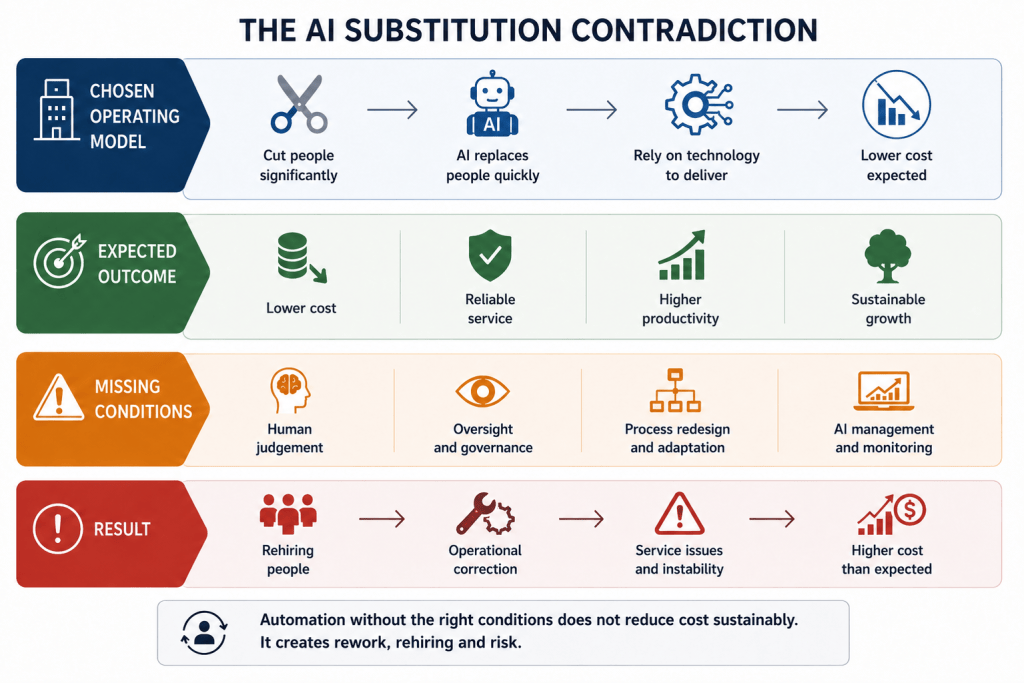
A recent example can be seen in companies that reduced staffing after adopting artificial intelligence, then discovered that reliable AI-enabled operations still required human judgement, oversight and technical support.
This article explains why management choices and expected business outcomes often become disconnected. It also presents a practical way for leaders to identify these contradictions before they become expensive operational problems.
The Decision Is Not Always the Problem
Management decisions rarely come with only benefits. Most choices create a combination of advantages, limitations and risks.
A centralised decision-making structure may improve consistency and control, although it will usually slow local decisions and reduce employee autonomy. Choosing lower-cost materials may reduce immediate spending, although it can also affect durability, reliability or the customer’s perception of quality.
The problem begins when management selects the advantages of one approach but continues to expect the advantages of another.
Leaders may choose centralisation because they want control, then become frustrated when employees do not behave like empowered owners. They may reduce training budgets to protect short-term profit, then complain that the organisation lacks the skills required for growth.
This creates an internal contradiction between the organisation’s stated objective and the conditions management has chosen to create.
Results do not follow intentions alone. They are shaped by decisions about resources, authority, incentives, processes and management behaviour. An organisation can describe the outcome it wants, but its operating choices determine which outcome it is more likely to receive.
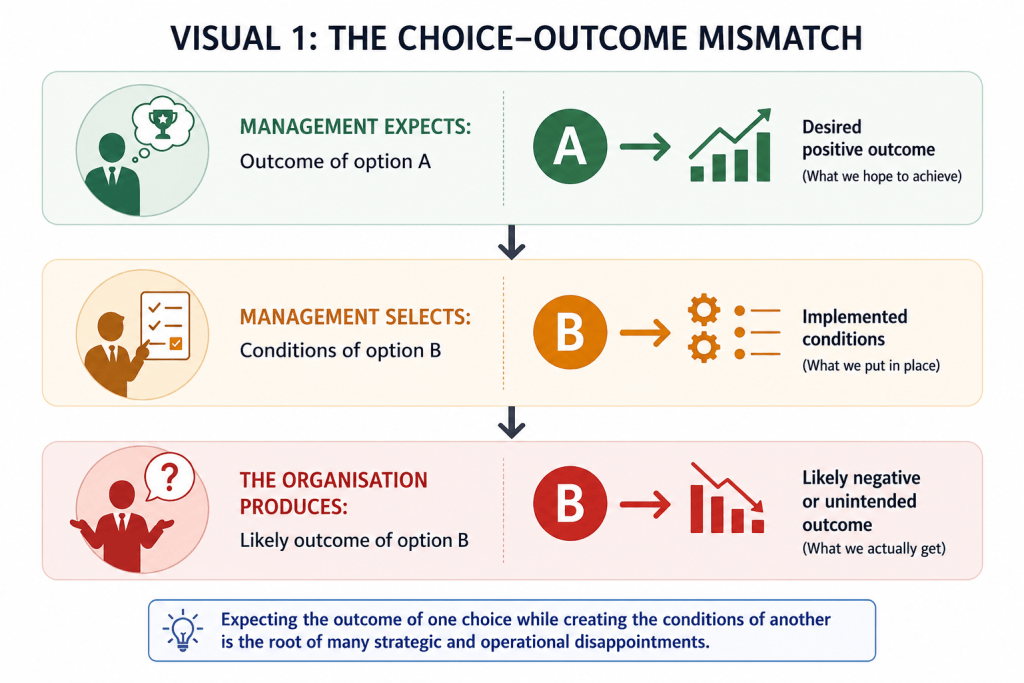
An organisation cannot consistently produce an outcome that its own management choices work against.
Expecting Innovation While Punishing Failure
Innovation involves uncertainty. Employees cannot test genuinely new ideas while guaranteeing that every attempt will succeed.
An organisation may still need to prevent careless decisions, repeated mistakes and experiments that create unacceptable risks. However, this is different from treating every unsuccessful test as evidence of poor performance.
When employees see colleagues criticised for reasonable experiments, they learn that supporting innovation is less important than avoiding visible failure. They begin proposing safer ideas, withholding unusual suggestions and waiting for senior approval before trying anything new.
Management may continue asking for creativity, but its response to failure has already communicated the real expectation.
An organisation that wants innovation must distinguish between an informed experiment and avoidable negligence. It should set clear boundaries, test ideas at an appropriate scale and learn from results that do not meet expectations.
Choosing innovation means accepting controlled uncertainty. Management cannot eliminate that uncertainty while still expecting employees to discover new products, services or operating methods.
Expecting Employee Ownership While Centralising Every Decision
Employees are often asked to behave like owners. They are expected to solve problems, take responsibility and act in the organisation’s best interests.
Ownership becomes difficult when employees lack the authority to make even routine decisions. A person who must seek approval for every adjustment eventually learns that their role is to follow instructions rather than exercise judgement.
Centralisation may be necessary for high-risk decisions, major expenditure or matters that affect the whole organisation. It becomes harmful when decisions are retained at senior levels simply because managers are uncomfortable giving up control.
The result is usually slower work and growing dependence on a small number of decision-makers. Employees stop bringing complete solutions because they know that management will make the final choice regardless.
If management wants ownership, it must define the decisions that employees may make and the boundaries within which they may act. Responsibility and authority do not need to be unlimited, although they must be reasonably aligned.
Management cannot retain all meaningful control and still expect employees to feel full ownership of the outcome.
Expecting Premium Quality While Choosing the Lowest-Cost Inputs
Cost control is necessary, and the most expensive option is not automatically the best. However, repeatedly selecting the lowest-cost input while expecting premium performance can become an expensive form of self-deception.
The consequences may appear through defects, rework, maintenance, delays or customer complaints. The purchase price remains low, although the total cost of producing a reliable outcome may increase.
The same principle applies beyond physical materials. An organisation may select the cheapest technology, external supplier or professional service while expecting responsiveness, expertise and reliability associated with a higher level of investment.
Good procurement should therefore consider the total value and operating consequences of a decision rather than focusing only on its immediate price.
A lower-cost choice may still be correct when the requirements are modest. The contradiction begins when management chooses an economy-level input while continuing to promise a premium-level result.
The solution is not to spend more on everything. It is to define the required outcome clearly and select inputs that are capable of producing it consistently.
Expecting Growth While Underinvesting in People, Systems and Capacity
Growth requires an organisation to handle more customers, transactions, decisions and operational complexity.
Management may want revenue to increase without adding unnecessary cost. However, sustained growth rarely comes from asking an unchanged operation to carry an indefinitely increasing workload.
Underinvestment may initially look like efficiency because existing employees produce more with the same resources. Over time, queues grow and maintenance is postponed. Training becomes harder to schedule while managers spend more time responding to daily problems.
The organisation may still achieve sales growth, although its service, quality and employee experience begin to weaken.
Good management asks what the operation must be capable of doing at the intended level of growth. It then identifies when additional people, technology, skills or capacity will be required.
Not every investment must be made in advance. Some can be introduced as demand reaches defined levels. What matters is recognising that growth has operational requirements.
An organisation cannot consistently expand its output while treating the capabilities needed to produce that output as optional expenditure.
Expecting Accountability While Responsibilities Remain Unclear
Accountability requires people to understand what result they own, what decisions they may make and how their performance will be assessed.
When responsibilities overlap, employees may assume that someone else is handling an issue. When gaps exist, important work may have no clear owner. Management may notice the problem only after an error or delay has already occurred.
It is then tempting to demand greater accountability from the people involved. However, stronger language cannot correct a structure that never made responsibility clear.
Good management defines ownership at important process steps and handovers. It also confirms who may approve, escalate or change the work when normal conditions do not apply.
Accountability should not mean finding someone to blame after the event. It should create enough clarity for people to act before the problem develops.
An organisation that wants accountability must give people identifiable responsibilities and the authority needed to fulfil them. Without those conditions, management is expecting an individual behaviour that its own operating design does not support.
Expecting Long-Term Loyalty While Managing Only for Short-Term Results
Organisations often want experienced employees who understand the business and remain committed through difficult periods.
At the same time, some management systems focus almost entirely on the next quarter. Training is reduced because its return will appear later. Roles are removed as soon as short-term demand falls, while workloads and employment conditions are changed with little consideration for long-term trust.
Employees observe these decisions and adjust their own behaviour. When the organisation treats the relationship as temporary, employees become more likely to manage their careers in the same way.
Long-term loyalty cannot be demanded as a personal virtue while management decisions repeatedly signal that the organisation itself is unwilling to make a long-term commitment.
This does not mean that businesses should retain every role regardless of economic conditions. It means that workforce decisions should consider capability, trust and future requirements alongside immediate cost.
An organisation receives stronger loyalty when employees can see that management considers the longer-term consequences of its decisions.
Expecting Collaboration While Rewarding Individual Competition
Collaboration requires people to share information, help colleagues and contribute to outcomes that may not be credited directly to them.
Individual performance measures can be useful, although problems arise when employees are rewarded only for their own visible output. Helping another team may then reduce the time available for achieving personal targets.
Sales teams may protect customer information. Departments may shift difficult work to one another. Employees may avoid sharing knowledge that gives them an individual advantage.
Management can hold meetings about teamwork, but the reward system continues to shape everyday behaviour.
A better approach combines individual responsibility with shared measures for outcomes that require cooperation. Managers should also recognise work that removes barriers for others, improves handovers or strengthens the complete process.
People normally pay attention to what the organisation measures and rewards. Management cannot design competition into the system and expect collaboration to appear simply because it is included among the company values.
The AI Workforce Reversal
A recent example shows how quickly a choice–outcome mismatch can become an operational problem.
On 21 May 2026, Reuters reported comments from TeamLease Services CFO Ramani Dathi about companies experimenting with AI-led workforce reductions. Dathi said that some firms had cut employee numbers by as much as 50% after adopting AI tools, only to return within months because they still needed people to manage the technology. TeamLease was advising clients to retain part of their workforce through flexible staffing arrangements while the effects of AI became clearer.
Gartner has made a related prediction specifically about customer service. It expects that by 2027, half of the companies that attributed customer-service headcount reductions to AI will rehire people to perform similar functions, although some roles may return under different titles. Gartner advised service leaders to focus on long-term growth rather than treating AI mainly as a route to immediate staffing reductions.
The contradiction can be expressed clearly:
They selected: rapid human replacement and immediate cost reduction.
They expected: dependable productivity, maintained service quality and successful AI adoption.
They discovered: these outcomes still required human judgement, exception handling, oversight and redesigned ways of working.
They chose AI substitution but expected the results of human–AI collaboration.
Start With the Outcome Before Choosing the Initiative
Management teams often begin with an initiative rather than the outcome they need.
They decide to centralise, automate, outsource or reduce staffing before defining precisely what the decision must achieve. The initiative then becomes the strategy, even when it does not address the complete operational requirement.
Good management begins by describing the desired outcome in observable terms.
“Improve customer service” is too broad. A clearer outcome might be to reduce response time while maintaining resolution quality and customer satisfaction. “Use AI to increase efficiency” should become a defined improvement in processing time, cost, capacity or accuracy.
Management should also identify which outcomes must not deteriorate. A cost-reduction decision may be acceptable only if safety, quality and service remain above specified levels.
This creates a more honest basis for evaluating alternatives. Leaders can compare whether each option is genuinely capable of producing the required combination of outcomes.
Beginning with the outcome does not guarantee that management will select the right option. It prevents the organisation from confusing the adoption of a popular initiative with the achievement of a useful result.
Identify the Conditions That the Expected Outcome Requires
Every important outcome depends on certain conditions.
Innovation requires room for controlled experimentation. Employee ownership requires delegated authority. Premium quality requires capable inputs and processes. Growth requires enough capacity to handle additional work.
Before approving a decision, management should ask:
What must be true for the result we expect to occur?
If a company expects AI to maintain customer service after reducing staffing, it may need reliable systems, high-quality data and clear escalation routes. It may also need employees who can manage exceptions and assess whether the AI’s response is appropriate.
The next question should be:
Does our selected option preserve or create those conditions?
This simple comparison reveals many contradictions. Management may discover that its cost-reduction plan removes the same expertise needed to make the technology work. A growth plan may depend on a department whose current capacity is already fully used.
The exercise should include operational requirements rather than only financial assumptions. A proposal can produce an attractive spreadsheet result while remaining incapable of working under real conditions.
Use a Choice–Outcome Consistency Test
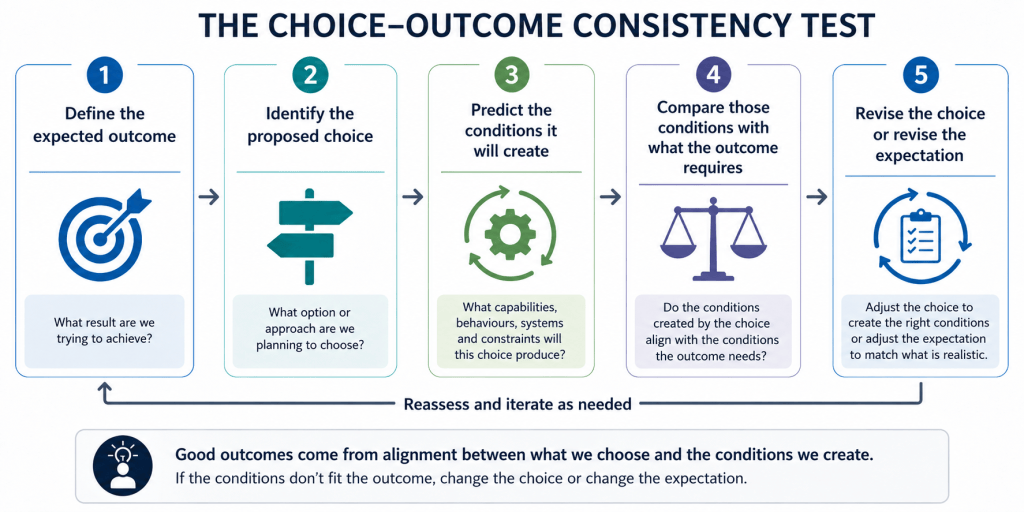
Before a major decision is approved, management should complete a deliberate consistency test.
The test can be organised around four questions:
1. What outcome do we expect?
2. What management choice are we making?
3. What behaviour and operating conditions will that choice create?
4. Are those conditions likely to produce the expected outcome?
For example, an organisation may want employees to identify and solve problems independently. It then proposes adding three approval levels to every process change.
The likely effect of the decision is greater dependence on management and slower local action. The choice therefore conflicts with the stated outcome.
This test should be performed before discussion becomes focused on implementing the preferred solution. Once leaders become emotionally or politically committed to an initiative, contradictory evidence becomes easier to dismiss.
The purpose is not to reject every imperfect option. Most decisions involve compromise. The purpose is to make the compromise visible and prevent management from expecting benefits that the selected option is unlikely to provide.
Separate Assumptions From Evidence
Many management mistakes begin as assumptions that gradually become treated as facts.
Leaders may assume that AI can handle most customer enquiries because a demonstration performed well. They may assume that employees have spare capacity or that customers will accept a lower level of personal support.
Before acting, management should write down the assumptions on which the proposal depends. Each assumption can then be classified as supported, uncertain or contradicted by available evidence.
Important uncertain assumptions should be tested before the organisation makes a difficult-to-reverse decision.
This does not require months of research for every change. A short pilot, operational observation or review of existing process data may provide enough evidence to challenge an unrealistic belief.
Management should pay particular attention to assumptions that make a proposal look unusually simple. Claims that a technology will remove work without creating oversight, maintenance or exception-handling requirements deserve careful examination.
A decision is not necessarily wrong because it includes uncertainty. The danger arises when management does not recognise that uncertainty and treats its preferred forecast as a guaranteed outcome.
Examine the Whole Operating System
A decision may improve one part of the organisation while weakening the complete process.
Reducing customer-service employees may lower staffing expenditure, but unresolved cases can move towards complaint teams, technical specialists or managers. Automating data entry may increase processing speed while creating more work for the people who must review incorrect outputs.
Management should therefore trace the likely effect of a decision across the whole operating system.
This includes upstream inputs, downstream work, customer experience, controls and employee responsibilities. It should also include the work required to maintain the new method.
The relevant question is not simply whether one activity becomes cheaper or faster. It is whether the complete process produces a better outcome after all consequences are considered.
This is especially important with AI because the visible automated task may represent only one part of the work. People may still be needed to prepare information, manage unusual cases and improve the system when conditions change.
Operational Excellence helps management move beyond isolated task savings and understand whether the organisation has genuinely improved its ability to create value.
Test the Operating Model Before Making Irreversible Changes
Management should avoid making permanent structural decisions based only on an early demonstration or forecast.
A pilot allows the organisation to see how a proposed model performs under real operating conditions. It can reveal the volume of exceptions and the level of employee oversight required. It can also show whether customers behave as expected.
In an AI implementation, management might first introduce the technology as support for employees rather than immediately removing roles. The organisation can measure how much work is genuinely eliminated and how much is changed or transferred.
The trial should include normal variation rather than only ideal cases. Peak demand, incomplete information and difficult customer situations often reveal weaknesses that are invisible during a controlled demonstration.
A pilot should also have defined success and stopping criteria. Without them, management may continue an unsuccessful initiative because too much prestige or money has already been attached to it.
Testing creates the opportunity to learn while the consequences remain manageable. It is usually less expensive to revise an assumption during a limited trial than to reverse a workforce or operating-model decision several months later.
Listen to the People Who Understand the Work
Senior leaders may understand the organisation’s strategy and finances, although they do not always see the detail of daily operations.
Employees who perform the work know where judgement is required and where customers behave unpredictably. They also know which informal activities prevent the process from failing.
These employees should not have an automatic veto over change. People can defend familiar methods even when improvement is necessary. However, excluding their knowledge creates a serious risk that management will remove activities whose value was never visible in the formal process.
When evaluating automation or restructuring, managers should ask employees what would happen if a task or role disappeared. They should explore who currently handles exceptions and how quality problems are detected.
Management should also invite disagreement from people outside the project team. A proposal becomes stronger when informed critics are allowed to test its assumptions before the organisation commits to it.
Good consultation is not a vote on whether change should occur. It is a disciplined effort to understand the system before changing it.
Align Measures and Incentives With the Outcome
An organisation may describe one priority while measuring and rewarding another.
Management may ask for long-term customer relationships while rewarding only monthly sales. It may encourage collaboration while ranking employees against one another. It may promote quality while evaluating purchasing teams only on price reductions.
Leaders should review the measures, targets and incentives attached to a proposed change. They should ask what behaviour a rational employee is likely to adopt under that system.
Where possible, measures should reflect the complete outcome. A cost target may be balanced with quality and service requirements. An individual performance measure may be combined with a team or process result.
This does not mean creating a large collection of indicators. Too many measures can make priorities less clear. The aim is to avoid rewarding behaviour that directly undermines the outcome management claims to want.
Management communication matters, but employees usually learn the organisation’s real priorities through decisions, measures and consequences.
Use Early Indicators and Be Willing to Correct the Choice
Management should decide in advance what evidence would show that its original assumption is wrong.
Waiting for final financial results may allow a problem to continue for too long. Earlier indicators can reveal whether the expected conditions are developing.
After an AI implementation, these indicators might include escalation volumes, correction rates and customer complaints. They may also include the time employees spend checking outputs and maintaining the technology.
Leaders should set review points before implementation rather than waiting until the decision becomes visibly unsuccessful. A review should compare actual effects with the original expected outcomes and assumptions.
Management must also create enough psychological and political room to change course. Leaders sometimes continue with a weak decision because reversing it appears to admit failure.
Correcting an informed decision after receiving new evidence is not poor management. Continuing to expect option A’s results after option B has repeatedly produced something else is the greater failure.
Make Alignment a Repeatable Management Practice
Avoiding choice–outcome contradictions should not depend entirely on whether one careful leader notices them.
A structured Operational Excellence management system can make the analysis part of normal decision-making. Before implementation, the organisation can examine feasibility, risk and operating capacity. It can identify the controls and employee capabilities required for the proposed model to work.
A system such as PATH OEMS™ supports this through the Plan, Align, Transform and Hold phases.
During Plan, management clarifies the problem and intended outcome.
During Align, it establishes ownership and tests whether the organisation has the conditions needed to proceed.
During Transform, it develops and tests the operating method before full implementation.
During Hold, it measures results and updates the process when evidence shows that the approved approach is no longer producing the intended outcome.
This structure helps management connect strategic expectations with operational reality. It does not remove uncertainty, although it makes hidden assumptions and contradictions easier to identify before they become expensive.
Many business failures are described as poor execution, weak culture or employee resistance. In some cases, the deeper problem is that management selected conditions that were unlikely to produce the outcome it expected.
The organisation wanted innovation but created fear of failure. It wanted ownership but retained every decision. It wanted quality and growth while withholding the inputs and capabilities those outcomes required.
The same error can occur when companies choose rapid AI substitution but expect the reliability and adaptability of human–AI collaboration.
Good management does not assume that a preferred initiative will automatically produce every desired benefit. It defines the outcome and identifies the conditions that outcome requires. It then tests whether the selected choice supports or contradicts those conditions.
The central principle is simple:
Management must either choose the conditions required for an outcome or adjust its expectations to match the conditions it has chosen.
An organisation cannot consistently select option B and continue expecting the results of option A.
Leave a Reply