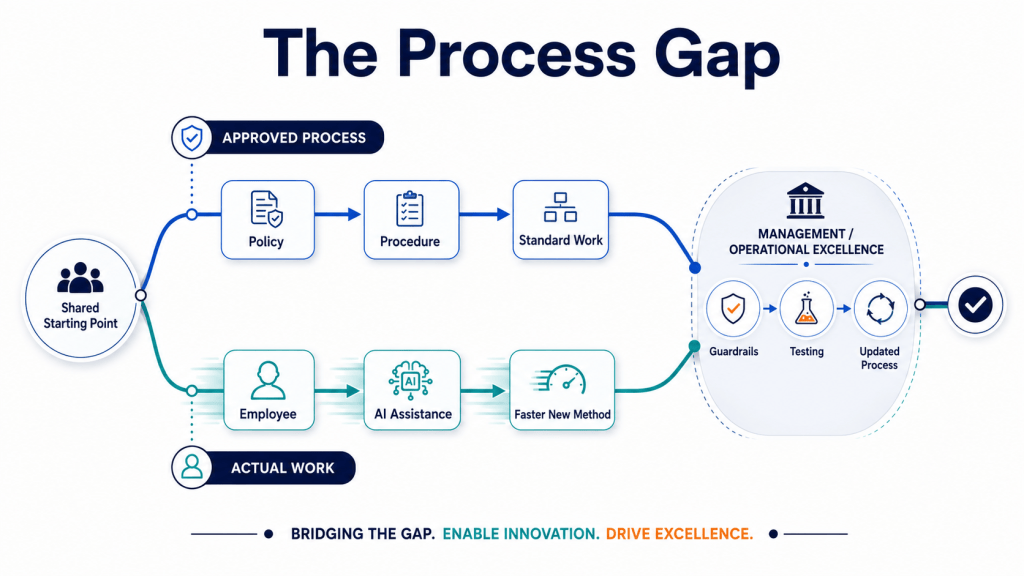
Employees are beginning to use artificial intelligence as a normal part of their work. They use it to draft documents, analyse information, prepare reports, solve problems and complete routine tasks more quickly. In many organisations, this change is happening before policies, procedures and approved processes have been updated to reflect it.
This leaves management with a difficult question. How can an organisation benefit from employees’ willingness to use AI without allowing actual working practices to move too far away from approved processes?
A recent global study by Boston Consulting Group found that AI is changing jobs faster than many organisations are redesigning the way work is managed. The findings suggest that the challenge is no longer limited to introducing AI tools. It now involves process governance, employee guidance, training, accountability and the design of work itself.
This article explains what the BCG study found, what those findings mean from an Operational Excellence perspective and how management can respond without unnecessarily slowing employees down.
What the 2026 BCG Study Found
BCG’s fourth annual AI at Work study was based on a survey of 11,749 employees, managers and leaders across 14 markets and a broad range of industries. It found that 74% of frontline employees now use AI every day or several times a week. This represents an increase of 23 percentage points from 2025.
The study also found that 42% of regular frontline users save at least eight hours each week through AI. This is equivalent to a full working day. However, 66% receive little or no guidance on what they should do with the time saved, while more than half do not reinvest that time in more strategic work.
The effects extend beyond productivity. Seventy-two per cent of respondents said that AI had changed the skills expected in their roles, yet only 36% believed that they had received adequate training. Only one-third of frontline employees reported receiving clear communication from leadership about AI. Even fewer saw a strong connection between what leaders were saying and what their organisations were actually doing.
The overall message is clear. Employees are not waiting for every policy, training programme and process document to be completed before they begin using AI.
What This Means for Operational Excellence
The BCG study does not prove that employees are deliberately ignoring policies or using prohibited tools. It does, however, suggest that actual working practices may be changing more quickly than organisations can formally review and approve them.
From an Operational Excellence perspective, this can create a growing gap between three versions of a process:
1. Work as documented: the method described in policies, procedures and process maps.
2. Work as performed: the method employees actually use during normal operations.
3. Work as it should be performed: the most effective method that also meets the organisation’s requirements for quality, risk and control.
When these three versions begin to move apart, the documented process gradually becomes less useful. It may describe manual activities that employees have partly automated, approval steps that are no longer followed in the same way or responsibilities that have shifted without being formally reassigned.
This does not mean that employee-led AI use is necessarily a problem. In many cases, employees are identifying waste and improving tasks that have remained unchanged for years. The Operational Excellence challenge is to turn those discoveries into controlled and repeatable improvements.
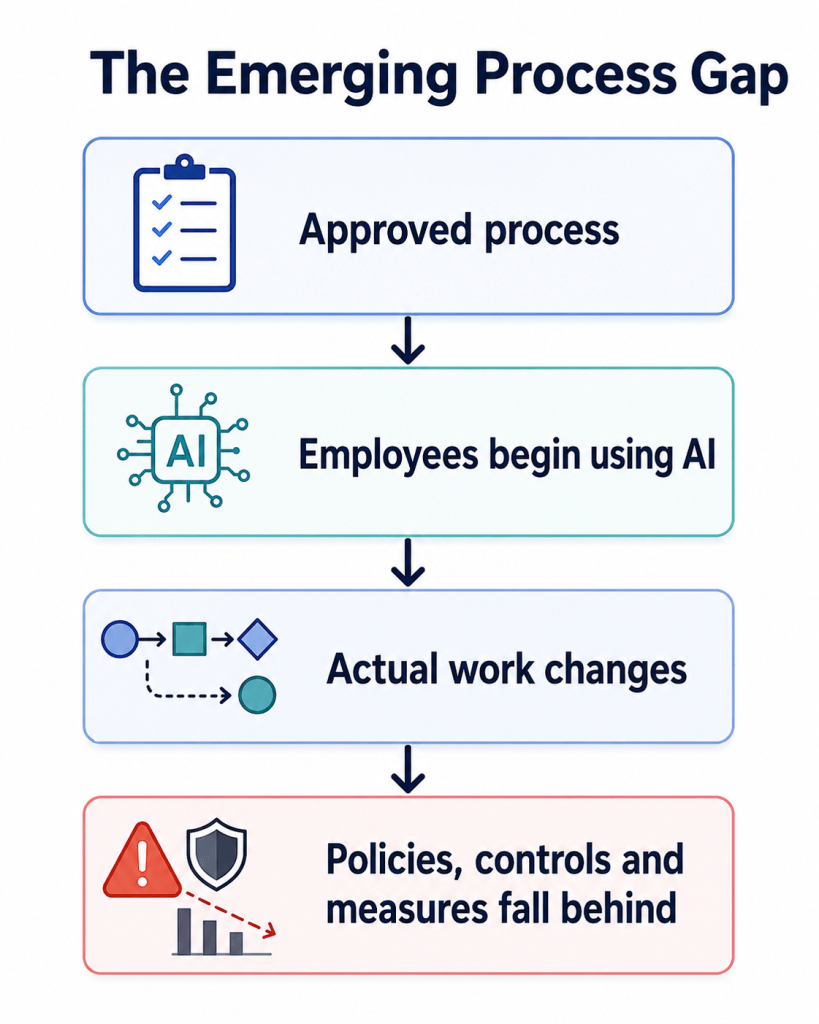
The longer this gap remains open, the more likely it is that different employees will develop different ways of completing the same work.
Why Organisations Naturally Move More Slowly Than Employees
An individual employee can change the way a task is completed in a matter of minutes. A large organisation cannot normally change an approved process at the same speed.
Management may need to consider data protection, cybersecurity, customer confidentiality, legal obligations and the effect on connected departments. The organisation may also need to test the new method, assign responsibility, update training material and confirm that the change works consistently.
This difference in speed is therefore understandable. It should not automatically be treated as poor management or resistance to innovation.
The problem arises when the difference becomes too large or continues for too long. Employees may begin to rely on informal practices that management cannot see clearly. Managers may continue measuring a process that no longer operates as designed, while training material may teach new employees a method that experienced employees have already abandoned.
Organisations cannot remove this difference in speed completely, but they can become much better at managing it.
1. Begin With Clear Guardrails Rather Than Detailed Procedures
Management does not need to understand every possible use of AI before giving employees useful direction. A short and practical organisation-wide policy can establish the minimum boundaries within which employees may experiment.
The policy should explain which AI tools are approved, what information must never be entered into them and which outputs require human review. It should also confirm that the employee remains responsible for the quality and accuracy of AI-assisted work.
Some decisions may require stronger restrictions. An organisation may decide that AI cannot independently approve payments, make employment decisions or provide final regulatory interpretations. These boundaries should be based on the level of risk rather than on a general fear of the technology.
The purpose of these guardrails is not to prescribe every prompt or every step. It is to create enough clarity for employees to use AI responsibly while the organisation continues learning.
A simple policy that is understood and regularly updated will often be more useful than a highly detailed procedure that takes months to approve and becomes outdated soon after publication.
2. Understand How Employees Are Already Using AI
Management cannot govern AI-enabled work effectively without first understanding how work is actually being performed.
This requires an open conversation with employees. Managers should ask which tools are being used, which tasks are being supported and what problems employees are trying to solve. They should also ask how outputs are checked and whether the new method has introduced additional work elsewhere in the process.
The tone of this exercise matters. Employees are less likely to share useful practices when they believe that admitting AI use may lead to punishment. Management should make it clear that the purpose is to understand the process and identify risks rather than to search for people to blame.
This discovery work may reveal both good and poor practices. One employee may have found a safe method that saves several hours each week, while another may be entering confidential information into a public tool without understanding the risk.
Both findings are valuable because they allow management to replace assumptions with evidence.
3. Classify AI Uses According to Risk and Value
Not every AI-enabled activity needs the same level of control.
Using AI to improve the wording of an internal email is different from using it to assess a customer application or interpret a legal requirement. Applying the same approval process to both activities would either create unnecessary bureaucracy or provide too little control for the higher-risk activity.
Management should classify existing and proposed uses according to their potential value and their level of risk.
Low-risk activities with clear benefits may be approved quickly under general guardrails. Higher-risk activities may require testing, specialist review, restricted tools and stronger human oversight. Activities that offer little value while creating serious risk may need to be stopped.
This approach allows the organisation to focus its attention where it matters most. It also prevents governance teams from becoming overwhelmed by large numbers of minor AI uses.
The aim is not to eliminate risk entirely. The aim is to understand the risk, decide whether it is acceptable and apply controls that are proportionate to the possible consequences.
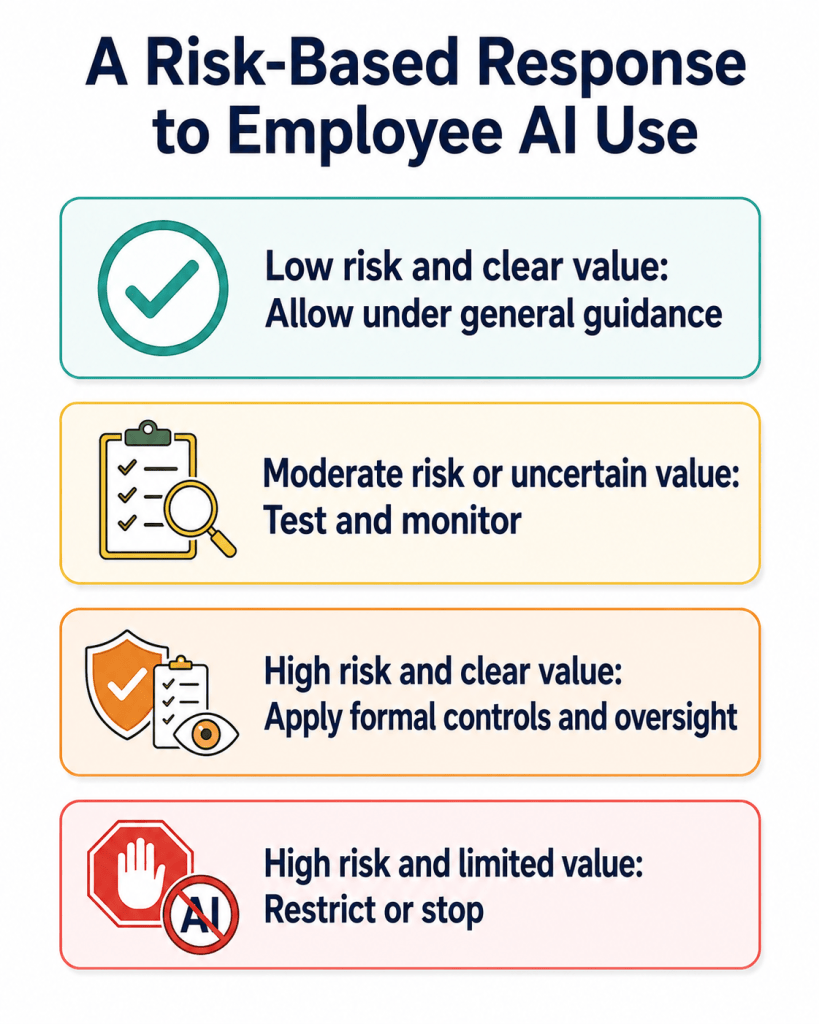
This prevents minor uses from becoming trapped in the same approval system as sensitive business decisions.
4. Introduce Provisional Standard Work
Many organisations treat an approved process as though it must remain unchanged for a long period. This approach becomes difficult when the technology supporting the process changes frequently.
A better option is to introduce provisional standard work. The organisation can approve the best-known method for a limited period while making it clear that the process will be reviewed after further use.
For example, a procedure might state that it is the approved method for the next 60 or 90 days. During that period, employees can record problems, benefits and unexpected effects. Management can then decide whether to retain, adjust or withdraw the method.
This approach maintains process control without pretending that the organisation has already found a permanent solution.
Provisional standard work should still have an owner, a version number and a review date. Employees should know which version is current and where to report concerns or improvement ideas.
Standardisation should capture the best reliable method currently available. It should not prevent the organisation from adopting a better method when evidence supports the change.
5. Redesign the Whole Process Rather Than Isolated Tasks
AI adoption often begins with individual productivity. An employee writes a report faster, summarises a meeting or prepares an initial analysis in less time.
These improvements are useful, but they do not always create an equivalent benefit for the organisation. A report may be completed earlier and then wait several days for approval. A faster analysis may create more work for the person responsible for checking it. Time saved in one department may simply move the bottleneck to another part of the process.
BCG found that employees in organisations redesigning workflows were 24 percentage points more likely to report measurable business improvement than employees in organisations focused mainly on providing AI tools. The study therefore recommends redesigning a smaller number of important processes from end to end rather than adding more tools to existing ways of working.
Management should examine how tasks connect across the complete process. It should then decide how roles, approvals, measures and customer outcomes need to change when AI removes or shortens part of the work.
6. Measure Business Outcomes Rather Than AI Adoption
The number of employees using AI is not, by itself, a useful measure of business improvement. High adoption may produce significant value, but it may also produce duplicated work, inconsistent outputs or time savings that are never used productively.
Management should therefore measure what changes after AI is introduced.
Depending on the process, this may include processing time, error rates, rework, customer waiting time, employee capacity or the cost of completing each transaction. Measures should cover the complete process rather than the speed of one isolated task.
The organisation should also decide what will happen to any capacity that is released. Employees might use the time to handle more work, improve customer service, address backlogs or carry out activities that were previously neglected.
BCG makes a similar distinction between adoption and value. Its research found that strategic clarity increased reported business impact by 25 percentage points, while better tools without clear strategy improved it by only about five points.
Technology creates potential capacity. Management determines whether that capacity becomes organisational value.
7. Use a Management System That Keeps Approved Processes Current
AI governance should not be treated as a one-off project that ends after the organisation publishes a policy. BCG recommends governing AI as a moving target through a standing system that regularly reviews what is working, measures value and adjusts the operating model as technology develops.
This is where an Operational Excellence management system such as PATH OEMS™ can support a more structured response.
During Plan, the organisation can identify where AI is already being used and determine which processes deserve attention first.
During Align, management can establish ownership, risk boundaries, decision rights and clear expectations for employees.
During Transform, teams can test promising practices and redesign selected processes while checking their effects on quality, cost, time and customer outcomes.
During Hold, the organisation can update standard work, train employees and monitor whether actual practice continues to match the approved method.
In this context, holding the gains does not mean freezing the process. It means maintaining control while continuing to review and improve the way work is performed.
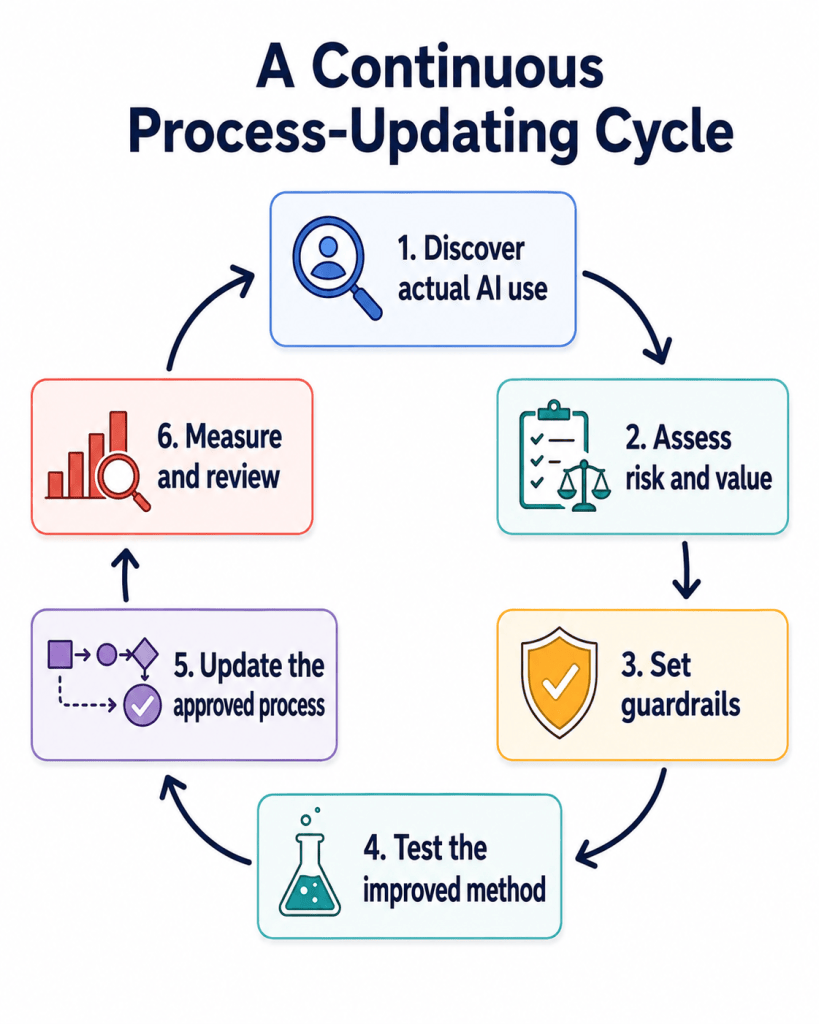
The cycle then begins again as tools, risks and working practices continue to change.
Employees’ use of AI is likely to continue changing work faster than many organisations can revise detailed policies and procedures. Attempting to stop all informal experimentation would remove many of the benefits that make AI valuable. Ignoring the change would create a growing gap between approved processes and actual work.
Management needs a position between these two extremes.
Organisations should establish clear guardrails, understand how employees are using AI and apply stronger controls where the risks are greater. They should approve provisional ways of working when appropriate and update them as evidence develops. Most importantly, they should redesign complete processes rather than measuring success through tool adoption or isolated time savings.
The goal is not to make organisational approval move at the same speed as individual experimentation. The goal is to create a management system that learns from employee innovation and turns it into safe, measurable and continuously updated standard work.
When this is done well, process governance no longer acts as a brake on AI-enabled improvement. It becomes the means through which that improvement can be sustained.
Leave a Reply