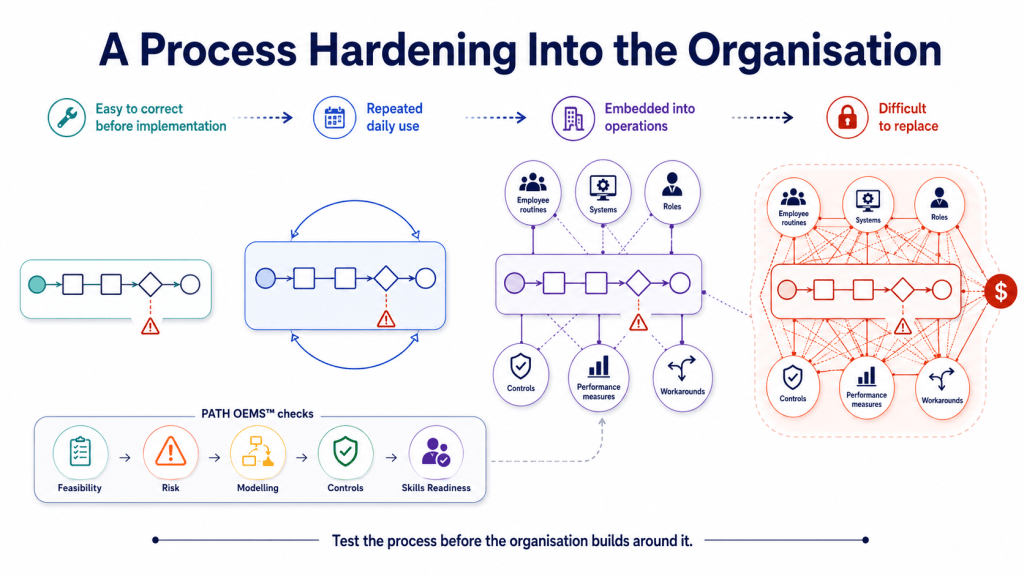
Bad habits are often described as sticky because repeated behaviour becomes easier to continue and harder to replace. A similar pattern can develop in operations when an organisation introduces a process that is impractical, poorly controlled or difficult for employees to follow.
Once people have repeated that process for long enough, it begins to shape roles, systems, measures and expectations. Employees develop workarounds. Managers become accustomed to the results. Connected processes adjust around its weaknesses. Correcting the original design can then require far more effort than designing it properly at the beginning.
This article explains why poor operational practices become difficult to change and what organisations can do to prevent that from happening. The main solution is to test a proposed process before it becomes the normal way of working.
Five tools within PATH OEMS™ support this work by checking feasibility, controls, operational performance, employee readiness and risk before a new or improved process is fully implemented.
Why Operational Habits Become Sticky
Research on human habits shows that repeated actions become closely connected to the setting in which they occur. Changing a lasting habit often requires a change in the surrounding context rather than relying only on a person’s intention to behave differently.
An organisation is more complex than an individual, although the comparison remains useful. Organisational research shows that routines can become persistent or path-dependent as they become connected to other routines, systems and organisational structures. The greater their level of repetition and interdependence, the more likely they are to become a source of inertia.
A process therefore becomes embedded through more than repetition. Employees are trained to follow it. Technology is configured around it. Performance measures begin to assume that it will remain in place. Suppliers and customers may also adjust their activities to accommodate it.
This means that a poorly designed process can continue even when most people recognise that it is inefficient. The organisation has already built too much around it to replace it easily.
The original mistake may have been small. The cost of correcting it grows as more parts of the organisation become dependent on the process.
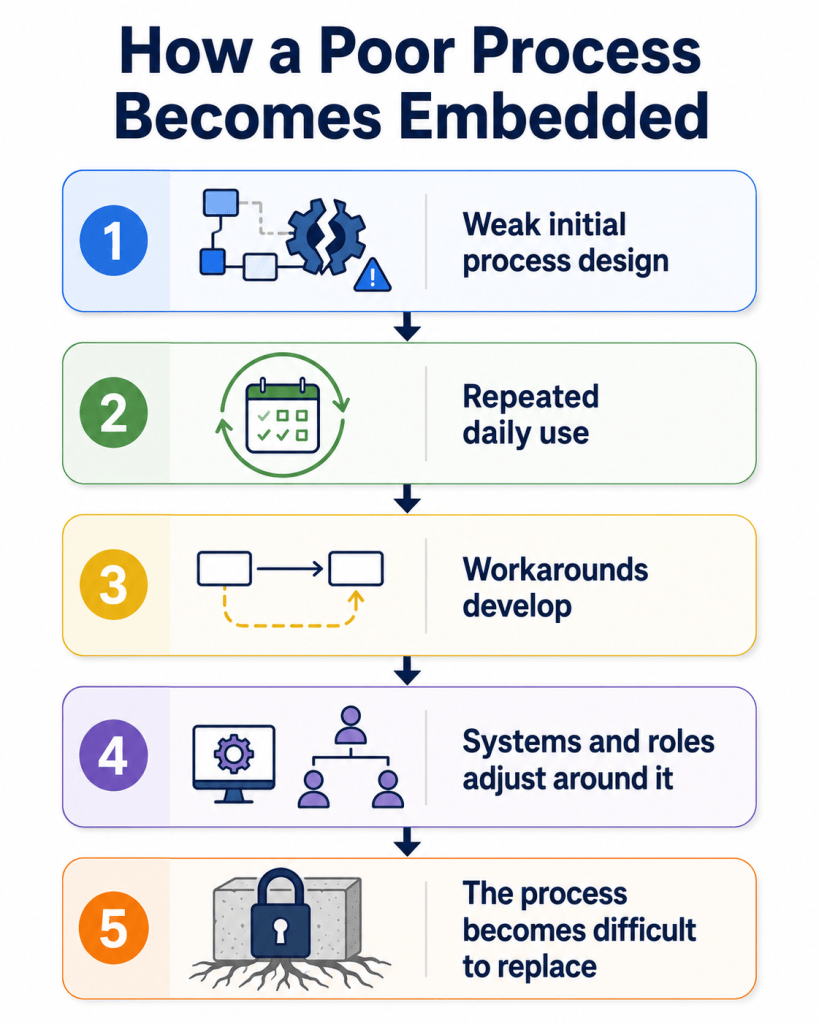
The process becomes harder to change because its weaknesses are gradually absorbed into the wider operation.
The Difference Between a Process and an Operational Habit
A documented process describes how work is expected to be completed. An operational habit develops when people repeat a particular way of working until it becomes the accepted or automatic method.
The two may be the same when the process is well designed and consistently followed. They can move apart when the formal process does not work under real operating conditions.
Employees may skip an approval that regularly causes delays. They may create their own spreadsheet because the approved system does not provide the information they need. They may also complete work in large batches because limited staffing makes the intended flow impractical.
These actions may solve an immediate problem, although they can create new risks and inconsistencies elsewhere. After enough repetition, the workaround becomes the actual process even though it was never formally assessed or approved.
Efficient organisational routines can become a source of advantage, while deficient routines can place the organisation at a disadvantage. The important question is therefore not whether routines will develop. It is whether the organisation is deliberately creating routines that support its objectives.
Why Correcting a Process Later Is So Expensive
Changing an established process involves more than drawing a new process map.
Employees may need to unlearn the old method and become confident in a replacement. Systems may require reconfiguration. Job descriptions, procedures, measures and controls may also need to change. Managers must continue delivering normal operations while supporting the transition.
Some employees may resist because the current process is familiar, even when they agree that it performs poorly. Others may have designed effective personal workarounds and worry that the new method will take those away.
Large corrective programmes can also create change fatigue when organisations repeatedly restructure work without addressing the original operational weaknesses. A 2026 Harvard Business Review article warned that repeated transformation cycles can drain morale and redirect management time and financial resources towards organisational clean-up rather than value creation.
This does not mean that organisations should avoid improving an established process. It means they should reduce the need for major corrections by testing new processes more carefully before they become embedded.
Prevention Begins Before the Process Goes Live
No process can be designed with complete certainty. Real-world implementation will always reveal issues that could not be fully predicted.
However, there is a considerable difference between accepting normal learning and launching a process without checking whether it is feasible, controlled or capable of handling expected demand.
The aim should be to reach the best practical design with the information currently available. The organisation can then test the process under controlled conditions and adjust it before poor practices spread across teams.
This requires several different forms of analysis because a process can fail in different ways. It may be technically impossible, operationally overloaded or dependent on skills that employees do not possess. It may also create risks that were not visible during initial design.
PATH OEMS™ brings these checks into the process-design stage through five purpose-built tools. They are applied according to the scale and risk of the proposed change rather than being completed as unnecessary paperwork for every minor adjustment.
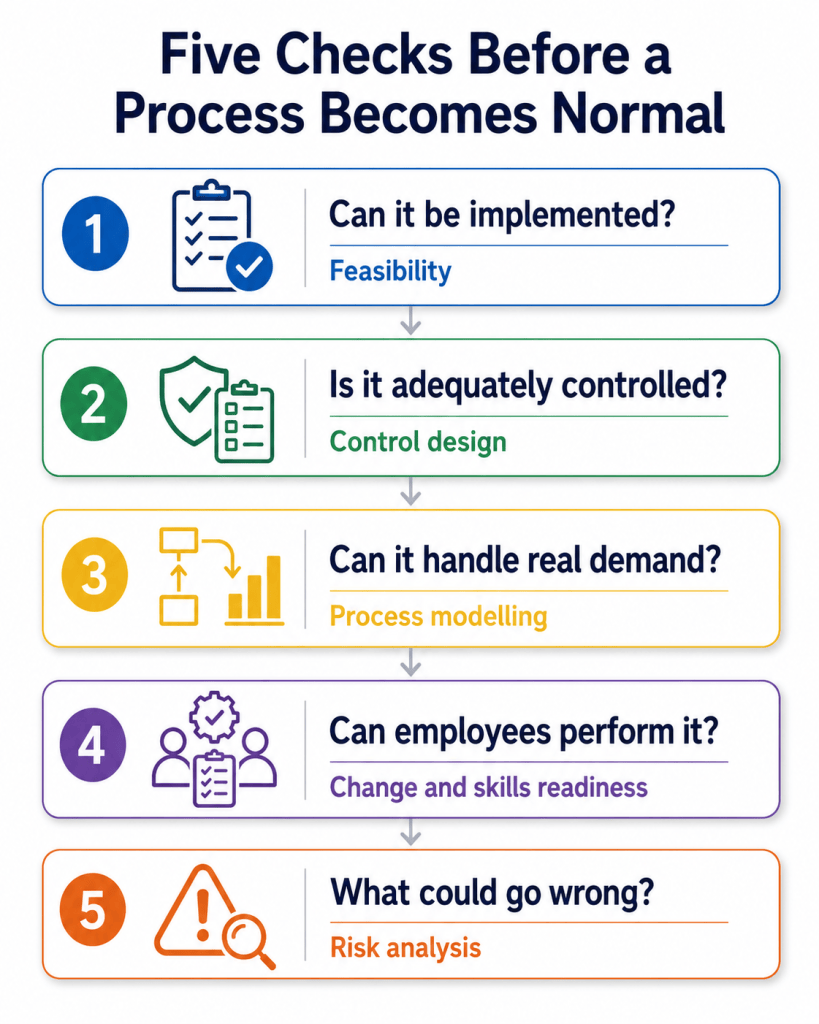
Together, these checks help the organisation move from a process that looks reasonable on paper to one that has a stronger chance of working in practice.
1. Use the PATH OEMS™ FEASIBILITY CHECK TOOL
A proposed process may appear logical while still being impossible to implement under the organisation’s actual conditions.
It may depend on technology that is not available or require approval from a group that lacks the capacity to provide it. The financial case may be unrealistic. Legal requirements, supplier limitations or physical constraints may also prevent the process from operating as intended.
The PATH OEMS™ FEASIBILITY CHECK TOOL is used to confirm that the proposed process is realistic and implementable across technology, cost, legal, compliance and operational considerations.
Begin by reviewing every important change introduced by the proposed process. Pay particular attention when it requires a new system, supplier, approval, role or significant financial commitment.
Next, identify the conditions that must exist before the process can work. A new system may require integration and testing. A revised approval route may require delegated authority. A new supplier may need to pass procurement and quality checks.
Finally, record every constraint or prerequisite and decide how it will be resolved before implementation. The design should be revised when a critical requirement cannot be met within a reasonable period.
This tool helps prevent an organisation from approving an attractive process that employees will later be forced to bypass because it was never workable.
2. Use the PATH OEMS™ CONTROL DESIGN TOOL
Controls are often added after something goes wrong. By that point, the process may already have caused errors, financial loss or compliance concerns.
The PATH OEMS™ CONTROL DESIGN TOOL helps organisations include the required checks, approvals and safeguards within the process from the beginning.
Start by examining the important failure modes connected with the proposed process. Consider what might happen if information is entered incorrectly, an approval is missed or a task is completed by someone without the necessary authority.
Then decide which controls are proportionate to the possible consequence. These may include system validations, approval limits, reconciliations, checklists, access restrictions or independent reviews.
The final step is particularly important. Each required control should be placed directly within the relevant process step and reflected in supporting procedures. A control listed in a separate assessment has little practical value when employees cannot see where it applies during normal work.
The tool is particularly useful where the process affects safety, finance, compliance, data integrity or customers. A lighter review may be sufficient when the work is low risk and easily reversible.
Well-designed controls support reliable performance without adding checks to every activity. The purpose is to control significant risk while allowing routine work to flow efficiently.
3. Use the PATH OEMS™ PROCESS MODELLING GUIDE
A process can be technically feasible and properly controlled while still failing under normal operating demand.
A new workflow may work during a small trial and then produce long queues when volumes increase. A faster step may send more work towards a team that already has limited capacity. Reducing staffing in one area may also increase turnaround time elsewhere.
The PATH OEMS™ PROCESS MODELLING GUIDE helps teams test whether the proposed process can handle expected volume, variability and operating constraints.
Begin with the most important operational assumptions. Estimate likely demand, available capacity, staffing levels, processing times and expected variation. The purpose is not always to construct an advanced mathematical model. A simple scenario comparison may reveal enough to support a decision.
Next, test realistic conditions rather than relying only on the average. Consider what happens during peak periods, staff absence, system downtime or unusually complex work.
The results should then be used to improve the process design. The team may need to increase capacity, change the sequence of work or remove a new bottleneck before implementation.
This guide is especially useful when demand is uncertain, queues already exist or the proposed change could move pressure from one process stage to another.
It helps prevent an organisation from introducing a process that works only when everything operates exactly as planned.
4. Use the PATH OEMS™ CHANGE IMPACT & SKILLS GAP TOOL
Processes do not operate independently of the people responsible for performing them.
A design may fail because employees were not told that their responsibilities had changed. A new system may be introduced without enough practice. Managers may also assume that an experienced employee can perform a new task because it appears similar to their current work.
The PATH OEMS™ CHANGE IMPACT & SKILLS GAP TOOL helps the organisation understand who will be affected and what each role needs before implementation begins.
Start by identifying every role involved in performing, approving or receiving work from the proposed process. Include people at handovers because many implementation problems appear between teams rather than within a single activity.
For each role, describe what will change. This may involve a new responsibility, system, decision, measure or escalation route. The organisation can then compare the required capability with the knowledge and skills currently available.
Use the results to provide only the support that is genuinely needed. This may include a short briefing, practical walkthrough, job aid, coaching or focused training session.
Readiness should be confirmed before launch by asking role owners to explain their responsibilities and escalation points. PATH OEMS™ then carries these identified support needs into implementation so that the process becomes usable in the real world.
5. Use the PATH OEMS™ RISK ANALYSIS TOOL
Feasibility asks whether a process can be implemented. Risk analysis asks what may happen when it is implemented.
The PATH OEMS™ RISK ANALYSIS TOOL is used to identify potential failure modes, understand their possible effects and determine which risks need to be addressed within the process design.
Begin by reviewing each important stage of the process and asking how it could fail. Consider incorrect inputs, missed activities, delays, unauthorised decisions, system failures and incomplete handovers.
Next, assess what each failure could affect. The consequences may involve safety, finances, compliance, service continuity, data integrity or organisational reputation.
The analysis should then identify practical actions that reduce the likelihood or consequence of significant failures. Required approvals and controls must be carried into the proposed process rather than remaining inside the risk document.
This tool should receive greater attention when the process includes regulated activities, high-consequence decisions or sensitive information. A lighter assessment may be enough for a minor administrative change with limited consequences.
Risk analysis and control design are closely connected, although they serve different purposes. Risk analysis identifies what could go wrong and where attention is required. Control design converts that understanding into specific safeguards within the way work will be performed.
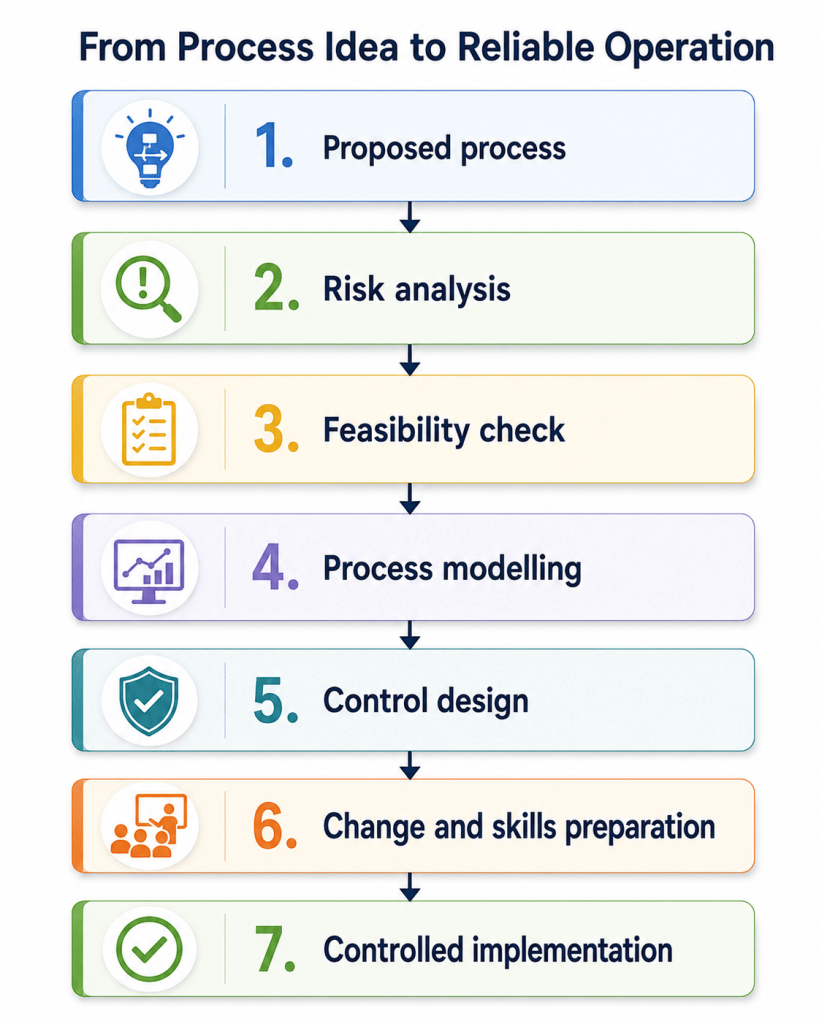
The order may change according to the process, and insights from one tool may require the team to revisit an earlier design decision.
Use the Tools as a Connected Design System
The five tools are most valuable when their findings are considered together.
A feasibility assessment may show that an automated control cannot be implemented with the current system. The team may then need to design a temporary manual control.
Process modelling may reveal that the manual control creates a queue. This may require a different approval threshold or additional capacity during peak periods.
The Change Impact & Skills Gap Tool may then show that the employees responsible for the new control need additional authority or training. Risk analysis may also reveal that allowing too many people to perform it would create a different problem.
This interaction is normal. Process design should develop through informed adjustment rather than a single attempt to produce the final answer.
The level of analysis should remain proportionate. A low-risk change affecting one person should not receive the same treatment as a process involving customer safety, regulatory compliance or significant financial decisions.
The purpose of the tools is to improve judgement and prevent avoidable failure. They should make implementation more reliable without turning process design into an unnecessarily long exercise.
Start With a Better Process Instead of Planning a Future Rescue
Organisations sometimes move quickly during process design because they expect to correct any problems after implementation. In practice, employees begin building habits and workarounds as soon as the process enters daily use.
Every week of poor operation makes the eventual correction more difficult. The organisation accumulates rework while employees lose confidence in the official method. Managers may then need a formal change programme to correct weaknesses that could have been found through several structured checks before launch.
PATH OEMS™ provides the complete tools, instructions and practical guidance needed to carry out these checks as part of a wider Operational Excellence management system. It guides practitioners through the work rather than leaving them to assemble a collection of disconnected templates.
Purchasing PATH OEMS™ provides access to the optimally designed:
1. PATH OEMS™ FEASIBILITY CHECK TOOL
2. PATH OEMS™ CONTROL DESIGN TOOL
3. PATH OEMS™ PROCESS MODELLING GUIDE
4. PATH OEMS™ CHANGE IMPACT & SKILLS GAP TOOL
5. PATH OEMS™ RISK ANALYSIS TOOL
These tools help organisations spend more time improving operations and less time correcting avoidable design mistakes.
Poor operational practices rarely remain isolated. Repetition turns them into routines, while systems, roles and expectations gradually form around them.
Correcting the process remains possible, although the work becomes more disruptive as the routine becomes embedded. The organisation may need to change technology, retrain employees and rebuild trust in the approved way of working.
A more efficient approach is to test the process before it becomes normal.
By checking feasibility, controls, operational performance, employee readiness and risk, organisations can identify many weaknesses while they are still relatively easy to correct. PATH OEMS™ brings these activities together within one practical system so that process design is supported by structured analysis rather than optimism alone.
Leave a Reply