Businesses are investing heavily in artificial intelligence, automation, and digital transformation, but the value created by these investments depends substantially on the operational environment in which they are deployed. New McKinsey research provides useful evidence on the relationship between operational excellence maturity, productivity, financial performance and technology adoption.
The McKinsey Operational Excellence Survey, published in June 2026, surveyed 1,000 managers and executives worldwide from companies with at least $500 million in annual revenue. McKinsey also matched 677 of the represented companies with historical financial performance data, allowing the research to examine how operational excellence maturity relates to business performance.
The research does not establish direct causation, but it identifies several strong relationships that are highly relevant to organisations pursuing process improvement, operational improvement and business transformation.
Finding 1: Higher Operational Excellence Maturity Is Associated With Stronger Financial Performance
One of the clearest findings is the relationship between operational excellence maturity and financial performance. McKinsey found that organisations with higher levels of operational excellence maturity showed materially stronger performance than less mature organisations.
Highly mature organisations achieved profit margin advantages comparable with companies that had advanced AI adoption. More significantly, McKinsey found that these organisations generated more than three times the three-year return on invested capital of less mature peers.
This finding is important because it connects operational excellence with outcomes that matter directly to business performance. Operational excellence is often discussed through individual methods such as process mapping, standardisation, performance measurement or continuous improvement. The research suggests that the greater value lies in how these practices operate together as a mature organisational system.
McKinsey associates higher operational excellence maturity with clear KPIs, disciplined resource allocation, real-time use of operational data, clear operating principles, continuous performance management, customer feedback, well-defined processes and clear decision rights.

These practices create a system through which organisations can translate strategy into execution, monitor performance, identify opportunities for improvement and sustain the resulting changes.
This finding is important because it connects operational excellence with outcomes that matter directly to business performance. Operational excellence is often discussed through individual methods such as process mapping, standardisation, performance measurement or continuous improvement. The research suggests that the greater value lies in how these practices operate together as a mature organisational system.
McKinsey associates higher operational excellence maturity with clear KPIs, disciplined resource allocation, real-time use of operational data, clear operating principles, continuous performance management, customer feedback, well-defined processes and clear decision rights.
These practices create a system through which organisations can translate strategy into execution, monitor performance, identify opportunities for improvement and sustain the resulting changes.
Finding 2: Operational Excellence Maturity Is Associated With Greater Productivity Improvement
The research also found a clear relationship between operational excellence maturity and productivity improvement. As operational excellence maturity increased, reported productivity gains also increased.
This relationship provides a practical explanation for how better operational management can contribute to stronger business performance. Improvements in throughput, variability, resource utilisation, process speed and decision quality can translate directly into stronger operating results.
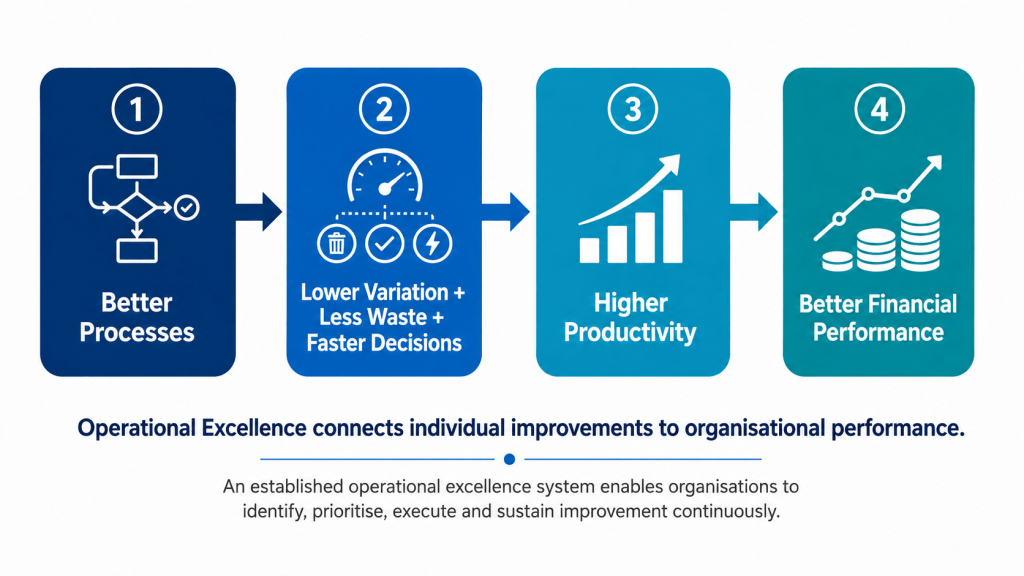
The value of individual improvement activities therefore depends on the operational outcomes they create. Process standardisation can reduce variation and rework. Better performance measures can support faster and more accurate decisions. Improved workflows can reduce delays and increase throughput. Stronger governance can ensure that improvement activity is directed towards areas with the greatest business value.
Operational excellence brings these activities together and creates the organisational capability to repeat them systematically.
This is particularly important because many organisations already conduct individual improvement projects. Those projects can generate significant benefits, but a mature operational excellence system enables the organisation to identify, prioritise, execute and sustain improvement continuously rather than relying on isolated initiatives.
Finding 3: Organisations With Stronger Operational Excellence Are Further Ahead in AI Deployment
McKinsey also found that organisations with more mature operational excellence practices were further advanced in deploying artificial intelligence.
This finding is especially relevant because many organisations are increasing investment in AI, automation and digital tools. McKinsey reports that almost 90 percent of organisations are experimenting with AI, while only 7 percent report having scaled it across the enterprise.
The difference between experimentation and enterprise scale is therefore likely to depend on more than access to technology. Scaling technology requires organisations to coordinate processes, data, resources, governance, responsibilities and performance management across functions.
McKinsey illustrates this through the example of a global automotive manufacturer. Before expanding its use of AI, the organisation examined its operating model and identified highly manual processes, technical debt and unnecessary complexity. It simplified processes and redesigned workflows before integrating AI more extensively.
The reported results included software development productivity improvements of up to 44 percent and approximately 40 percent growth in incoming orders associated with AI supported sales tools.
The example demonstrates the importance of operational readiness. Technology creates greater value when it is introduced into processes that are understood, structured and capable of supporting change.
For organisations considering AI or automation, process improvement therefore becomes an important part of technology deployment. Improving the operating environment first can increase the organisation’s ability to use technology effectively.
Finding 4: The Strongest Results Appear When Technology and Operational Excellence Are Combined
The final finding brings the previous results together. McKinsey found that organisations combining advanced technology with strong operational excellence practices reported the greatest productivity improvements.
The case studies presented in the research reinforce this relationship.
At Siemens’ Nanjing site, stronger operational foundations accompanied the deployment of digital twins. The site subsequently reported a 50 percent increase in units per hour, an 83 percent reduction in delivery lead time and a 12 percent reduction in cycle time.
At CITIC Dicastal’s Morocco operation, technology was embedded into structured production and improvement processes. The organisation reported a greater than 30 percent reduction in defects, a 17 percent increase in overall equipment effectiveness and a 27 percent increase in labour productivity.
These results illustrate the complementary relationship between technology and operational excellence. Technology can increase speed, analytical capability, automation and scale, while operational excellence provides the processes, governance, measures and improvement discipline required to direct those capabilities towards sustained performance.

What These Findings Mean for Organisations
Taken together, McKinsey’s findings provide a clear picture. Higher operational excellence maturity is associated with stronger financial performance, greater productivity improvement, more advanced AI deployment and stronger results when technology and operational practices are combined.
The research does not suggest that operational excellence alone guarantees these outcomes, nor does it establish direct causation. It does, however, show that organisations with stronger operational systems consistently perform better across several important measures.
This has practical implications for organisations pursuing transformation. Investments in AI, automation, software and analytics should be considered alongside investments in processes, governance, performance management and improvement capability.
An organisation that develops these capabilities creates a stronger foundation for identifying opportunities, implementing changes, measuring results and sustaining improvement over time.
For organisations considering major investments in technology or transformation, one question is therefore particularly useful: Does the organisation have the operational capability required to convert this investment into sustained performance improvement?
Build a Repeatable Operational Excellence Capability
PATH OEMS™ provides the structured methodology, processes and tools required to deploy Operational Excellence using existing organisational resources.
It enables organisations to establish a systematic approach for planning, managing, implementing and sustaining improvement.
Explore PATH OEMS™ and start building your organisation’s Operational Excellence capability →
Primary research: McKinsey & Company, Putting AI to work: The operational excellence imperative, published June 19, 2026. The research surveyed 1,000 managers and executives globally and analysed historical financial performance data for 677 represented companies.
Leave a Reply