The labour market is changing quickly as artificial intelligence, automation, demographic shifts and new business models reshape how organisations operate. For professionals entering the workforce or considering which capabilities to develop next, the practical question is increasingly straightforward: which skills will remain valuable as jobs change?
The World Economic Forum’s Future of Jobs Report 2025 provides an important indication. The report draws on more than 1,000 employers across 22 industries and 55 economies, representing more than 14 million workers. It estimates that structural changes in the global labour market will create approximately 170 million jobs and displace 92 million by 2030. It also estimates that 39 percent of workers’ existing skill sets will be transformed or become outdated during the 2025 to 2030 period.
Among the findings is one that deserves particular attention from anyone interested in Operational Excellence and Process Improvement. The World Economic Forum identifies resource management, operations, and quality control among the skills showing marked differences in both importance and proficiency between growing and declining jobs.
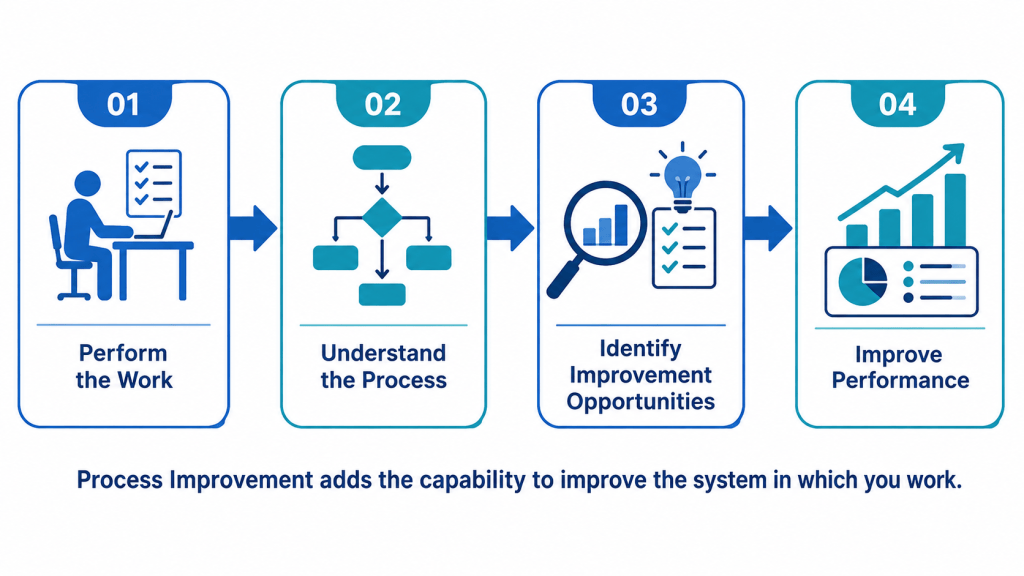
Process Improvement develops capabilities closely connected with both areas. Professionals learn to understand how work is performed, identify performance problems, analyse processes, improve the use of resources, reduce variation, improve quality and measure whether changes deliver results.
This makes Process Improvement a particularly relevant professional capability in a labour market where employers increasingly need people who can help organisations perform better.
Operations Skills Are More Strongly Associated With Growing Jobs
The World Economic Forum compared the skills associated with occupations expected to grow with those associated with occupations expected to decline. The comparison considered both how important a skill is to a role and the level of proficiency required.
Resource management and operations showed marked gaps in both dimensions, meaning that these skills are more important and require greater proficiency in growing roles than in declining ones. Quality control displayed a similar pattern.
This finding has direct relevance to Process Improvement.
A person with Process Improvement capability can examine how resources, activities, decisions and information move through an organisation. They can identify delays, unnecessary work, variation, bottlenecks and other performance problems, and they can help redesign processes to improve results.
These capabilities apply across industries because almost every organisation operates through processes.
A hospital manages patient processes, a bank manages financial and customer processes, a manufacturer manages production processes, a technology company manages development processes, and a government body manages administrative and service delivery processes.
The specific processes differ, but the ability to understand and improve how work gets done remains transferable.

Quality Skills Also Differentiate Growing From Declining Roles
The same World Economic Forum analysis identifies quality control as another skill with marked importance and proficiency gaps between growing and declining jobs.
Quality is closely connected with Process Improvement because organisations need more than the ability to perform work quickly. They need processes that produce reliable outcomes.
Improving quality involves identifying where errors, defects, rework, customer dissatisfaction or process variation occur and changing the conditions that create them. This requires analytical thinking, process understanding, measurement and structured problem solving.
These skills can provide value well beyond jobs carrying titles such as Process Improvement Analyst, Lean Specialist or Operational Excellence Manager. A project manager who can improve a delivery process, an operations manager who can reduce delays, a business analyst who can identify process inefficiencies and a team leader who can improve quality all bring an additional capability to their primary profession.
Process Improvement therefore works particularly well as a complementary skill. Professionals can combine it with expertise in engineering, finance, healthcare, product management, operations, technology, administration or many other disciplines.
Employers Are Prioritising People With New Skills
The broader workforce findings reinforce the importance of developing capabilities that organisations will need in the future.
The World Economic Forum reports that 63 percent of surveyed employers identify skill gaps as a major barrier to business transformation. In response, 85 percent expect to prioritise workforce upskilling and 70 percent expect to hire employees with new skills during the period to 2030.
This means employability will increasingly depend on the capabilities a person can bring to an organisation rather than relying exclusively on their existing job title or qualification.
Technology skills will clearly play an important role. AI and big data, networks and cybersecurity, and technological literacy are among the fastest-growing skills identified by employers. However, the report also highlights analytical thinking, systems thinking, resilience, leadership and operational capabilities.
This combination matters because organisations need employees who can do more than use new technology. They also need people who can determine where problems exist, understand how systems work, decide where resources should be directed and improve organisational performance.
Process Improvement sits naturally within this combination of analytical, operational and problem-solving capabilities.
The Ability to Improve Organisations Becomes More Valuable During Transformation
The World Economic Forum expects considerable disruption to the labour market. It estimates that 22 percent of current jobs will be affected by creation and displacement between 2025 and 2030, while almost two-fifths of existing worker skills are expected to change or become outdated.
At the same time, employers are transforming their businesses. Half expect to reorient their businesses in response to AI, while technological change is expected to drive significant changes in skills requirements.
Transformation creates a practical organisational requirement: somebody has to convert change into better performance.
New systems have to be integrated into processes. Workflows have to be redesigned. Responsibilities have to be clarified. Performance has to be measured. Problems have to be identified. Resources have to be prioritised, and improvements have to be sustained.
These are areas in which Process Improvement capability becomes useful.
A professional who understands both their functional discipline and how to improve the processes surrounding it can contribute to transformation in a different way from someone whose expertise is limited to performing the existing work.
The distinction is important for employability. Organisations naturally value people who can perform their responsibilities effectively. They can gain additional value from people who can also identify how those responsibilities, processes and systems can be performed better.
The World Economic Forum does not state that learning Process Improvement automatically makes someone employable, and no individual skill can guarantee employment.
Its findings support a more useful conclusion.
Skills related to operations and quality are materially more prominent in growing occupations than declining ones, while employers simultaneously report substantial skills shortages and an increasing need to recruit people with new capabilities.
Process Improvement develops capabilities that align closely with these needs. It teaches people to understand work systematically, analyse performance, identify problems, use evidence, improve processes and connect changes with measurable results.
For students and fresh graduates, this can differentiate them from candidates whose experience consists primarily of academic knowledge. They can enter interviews able to discuss how organisations operate and how performance can be improved.
For established professionals, Process Improvement adds a capability that can be applied within their existing discipline. An engineer can become an engineer who improves processes. A finance professional can improve financial processes. A project manager can improve project delivery. An operations professional can systematically improve operational performance.
As organisations face increasing pressure to adopt technology, improve productivity and transform their operating models, the ability to improve how work gets done is likely to remain broadly useful.
Primary source: World Economic Forum, Future of Jobs Report 2025. The report draws on responses from more than 1,000 employers across 22 industries and 55 economies representing more than 14 million workers.
Leave a Reply