Siemens reported its highest-ever quarterly industrial profit on 6 August 2026, providing a timely example of how artificial intelligence, automation and digital technology are increasingly moving from general business applications into the processes through which organisations actually operate.
For the third quarter of its 2026 financial year, Siemens reported €27.9 billion in orders, €20.8 billion in revenue and €3.5 billion in profit from its Industrial Business. Industrial Business profit increased 25 percent compared with the same quarter a year earlier, while its profit margin rose from 14.9 percent to 17.3 percent. Siemens also increased its full-year earnings guidance following the strong results.
Reuters linked the performance partly to rising global investment in artificial intelligence and reported strong demand for Siemens technologies serving data centres, smart factories and electronics manufacturers. Siemens itself reported triple-digit order growth in its data centre business during the first nine months of the financial year and 18 percent growth in its digital business.
The results are significant for operational excellence because they illustrate an increasingly important development in business transformation. AI is creating substantial economic opportunity when organisations connect it with physical operations, industrial processes, automation, infrastructure and productivity.
Industrial AI Is Moving Closer to the Processes That Create Value
Much of the public discussion around artificial intelligence has focused on generative AI applications that assist individual employees with activities such as writing, analysis, research and administration. Siemens operates in a different part of the AI opportunity.
Its industrial technology portfolio applies digital capabilities to factories, infrastructure, engineering, automation and other operational environments. Reuters reported that Siemens is benefiting from demand related to industrial AI, smart factories and the infrastructure required to support AI-intensive operations.
This matters because business value is ultimately created through operating processes. Products have to be designed, produced and delivered. Equipment has to operate reliably. Resources have to be allocated effectively. Quality has to be controlled, customers have to be served, and operational decisions have to be made.
Artificial intelligence becomes particularly valuable when it improves these activities.
The opportunity therefore extends beyond making individual knowledge workers faster. Industrial AI can support organisations in improving the design, control and execution of the processes that determine their operational performance.
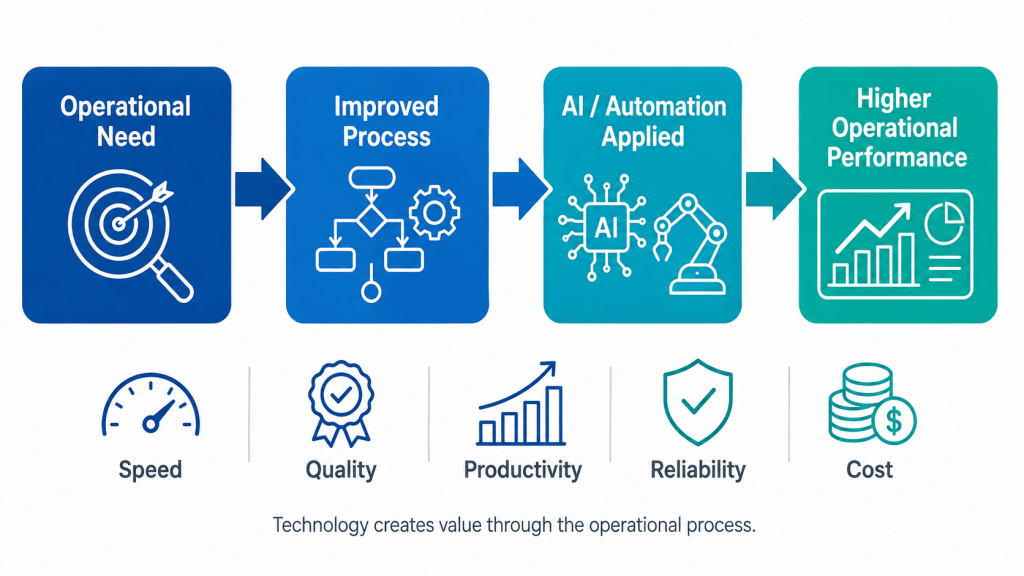
For organisations pursuing operational excellence, this creates a useful principle: technology investments become more strategically valuable when they address measurable operational needs.
Productivity Remains Central to the Business Case for Technology
Siemens CEO Roland Busch has positioned industrial AI around improvements in productivity and competitiveness. This emphasis is important because productivity provides a direct connection between technology investment and business performance.
Technology can create impressive capabilities without necessarily creating an equally impressive economic return. The business case becomes stronger when those capabilities improve throughput, reduce processing time, lower variation, improve asset utilisation, accelerate engineering work or reduce the resources required to produce the same output.
Siemens’ own portfolio reflects this relationship. Its activities span automation, industrial software, digital twins, electrification and industrial AI, all of which can influence the performance of operational systems when deployed effectively.
This places process improvement at the centre of the technology discussion.
An organisation seeking to increase productivity needs to understand where work slows down, where variation occurs, which activities consume unnecessary resources, where decisions are delayed and which constraints have the greatest effect on output. Technology can then be applied against defined operational problems.
The sequence matters because a clearly understood process gives an organisation a stronger basis for deciding what should be automated, augmented, redesigned or eliminated.
Apply Technology Within a Structured Operational Excellence System
PATH OEMS™ provides organisations with a structured approach for deploying Operational Excellence using their existing people and technology resources.
It provides a systematic route for identifying improvement opportunities, aligning resources, transforming processes and sustaining the resulting improvements, helping organisations connect technology investments with wider operational objectives.
AI Transformation Increasingly Requires Operational Infrastructure
The Siemens results also demonstrate the scale of physical and organisational infrastructure required by the expansion of AI.
Reuters reported particularly strong demand for Siemens’ smart infrastructure business as companies invest in data centres and other AI related facilities. Siemens stated that it works with nine of the world’s ten largest data centre providers, while orders in its data centre business increased at a triple digit rate during the first nine months of its financial year.
This provides an important reminder that digital transformation has physical and operational requirements.
AI requires computing infrastructure, power distribution, equipment, controls, software, data and supporting processes. Industrial applications introduce additional requirements involving production systems, engineering workflows, maintenance, quality management and operational governance.
As AI moves deeper into organisations, transformation therefore becomes increasingly connected with the design and management of the wider operating system.
This creates a stronger role for operational excellence. Organisations need mechanisms for identifying where technology can produce value, redesigning the processes affected by it, establishing appropriate performance measures, assigning responsibilities and monitoring whether the expected improvements actually occur.
A technology implementation can therefore be viewed as one component of a broader operational transformation rather than as an isolated technology project.

Technology and Operational Excellence Are Complementary Capabilities
The Siemens results should not be interpreted as evidence that AI alone produced the company’s record profit. Siemens operates across multiple businesses and benefited from several sources of demand during the quarter. Its Digital Industries business also faced areas of weaker demand, demonstrating that the overall picture is more complex than a simple relationship between AI and profitability.
The broader operational lesson remains important.
Technology increases what an organisation is capable of doing. Operational excellence determines how systematically those capabilities are directed towards performance.
AI can increase analytical capability. Automation can increase execution speed. Digital twins can improve modelling and simulation. Industrial software can improve information flow and engineering productivity.
Operational excellence provides the complementary mechanisms required to determine which processes should improve, which opportunities deserve priority, how performance should be measured, how responsibilities should be assigned and how successful improvements should be sustained.
These capabilities become particularly important as technology reaches more complex and interconnected parts of an organisation.
A poorly selected automation opportunity can accelerate work that creates little value. An improvement system can instead identify where the greatest constraint or opportunity exists and direct technology towards that area.
This distinction turns technology deployment into operational improvement.

What Siemens’ Results Mean for Organisations Pursuing Transformation
Siemens’ record quarter provides a useful example of a wider shift taking place in business. Artificial intelligence is increasingly becoming part of industrial infrastructure, operational processes and the systems organisations use to produce goods and services.
That development should influence how organisations approach AI transformation.
The starting point should be the performance of the organisation rather than the availability of a particular technology. Leaders can identify where productivity is constrained, where process performance is inconsistent, where decisions are slow, where quality problems occur, and where existing resources are being used inefficiently.
Technology can then be evaluated according to its ability to improve those conditions.
This creates a more disciplined approach to transformation because investment becomes connected to defined operational outcomes. It also makes the resulting benefits easier to measure.
For operational excellence practitioners, the growing adoption of industrial AI therefore represents an opportunity rather than a competing management trend. AI, automation and digital technologies increase the range of solutions available for improving processes. Operational excellence provides the management system required to select, implement and sustain those improvements effectively.
The strongest organisations are likely to develop both capabilities together: increasingly sophisticated technology and increasingly mature systems for managing operational performance.
Build the Operational System Behind Transformation
PATH OEMS™ provides the methodology, processes and tools required to establish Operational Excellence using an organisation’s existing human and technology resources.
It enables organisations to identify, prioritise, implement, measure and sustain improvement systematically, providing the operational structure within which technologies such as AI and automation can contribute to wider business performance.
Explore PATH OEMS™ and build a repeatable Operational Excellence capability →
Sources: Reuters, Siemens rides AI boom to post its highest-ever industrial profit, 6 August 2026. Siemens AG, Record third quarter – Outlook raised and Q3 FY2026 financial results, 6 August 2026.
Leave a Reply